

Many buyers consider Bhaisepati when they want a quieter residential environment while remaining connected to Lalitpur and Kathmandu. It sits close enough to the Ring Road to stay practical, while still offering more space than the city’s denser central neighbourhoods. Whether you’re comparing houses, looking at residential plots, or trying to work out whether the area makes sense as a long-term investment, this guide covers what buyers actually need to know about property in Bhaisepati.
Punarvaasu Nepal helps buyers explore verified residential properties across Kathmandu Valley, with guidance on locations including Bhaisepati and surrounding Lalitpur areas. Here’s a closer look at the area, what’s currently available, and what to check before you buy.
Where Is Bhaisepati Located?
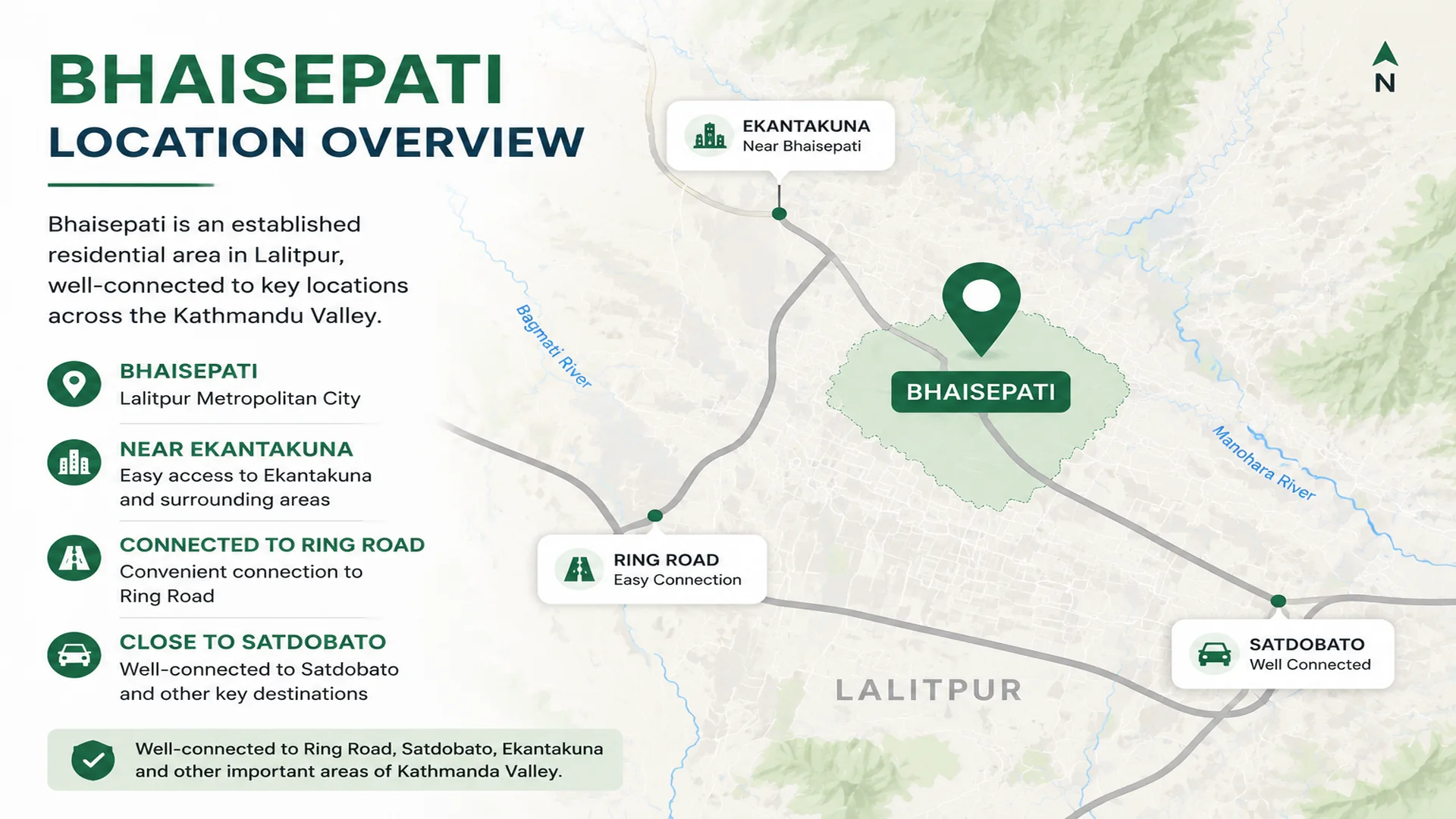
Bhaisepati falls under Ward 25 of Lalitpur Metropolitan City, on the southern side of the Kathmandu Valley. It borders Ekantakuna to the north, connects toward Nakkhu and Satdobato, and sits within reasonable reach of Bungamati and Khokana further south. The area’s main draw for buyers is its access to the Ring Road via Ekantakuna, which keeps travel into central Lalitpur and onward into Kathmandu manageable without living inside the traffic and congestion of those areas directly.
For property buyers, this location matters in a practical sense rather than a scenic one. Bhaisepati offers enough distance from the city core to allow larger plots and quieter residential streets, while still keeping schools, hospitals, and daily errands within a reasonable drive. That combination — space without total disconnection — is the main reason the area keeps coming up in buyer searches, alongside comparable southern Lalitpur locations such as Imadol.
Why Buyers Are Choosing Bhaisepati

Most buyers looking at Bhaisepati aren’t chasing an investment story first — they’re looking for a place to actually live, and the area’s appeal comes down to a few consistent factors.
The first is space. Compared to plots inside Kathmandu’s older, denser neighbourhoods, Bhaisepati still allows for larger residential land parcels and homes with parking, gardens, and room to build without feeling boxed in by neighbouring structures. For families moving out of rented apartments in the city centre, that difference alone is often the deciding factor.
The second is the residential character of the area itself. Much of Bhaisepati has developed around planned housing colonies rather than ad-hoc construction, which tends to mean better-organised streets, more predictable road access, and a more settled, family-oriented atmosphere than areas still in the middle of dense, unplanned growth.
Healthcare access is also a genuine draw — Nepal Mediciti sits within the Bhaisepati area itself, which matters for families weighing long-term convenience alongside price. Combined with reasonable access to schools and daily markets nearby, Bhaisepati works well for buyers prioritising a settled, practical home base over proximity to the city centre.
None of this means the area is without trade-offs — commute times into central Kathmandu will run longer than a Jawalakhel or Pulchowk address — but for buyers who’ve already decided that trade is worth making, Bhaisepati consistently comes up as one of the stronger options in southern Lalitpur.
Many younger families and working professionals consider Bhaisepati when they move from rented housing toward home ownership. For this group, the area’s organised colony infrastructure and genuinely quieter daily environment tend to outweigh the longer commute — particularly for households where at least one member works from home or has flexible hours.
Houses for Sale in Bhaisepati
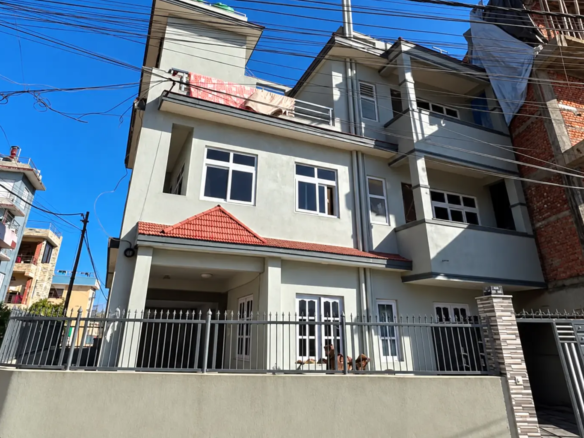
The housing stock in Bhaisepati is a mix of standalone family homes, bungalows, and houses built within organised colony developments, generally ranging from smaller 3–4 aana plots up to larger 6 aana-plus properties depending on budget and location within the area.
Most houses on the market fall into a few recognisable categories: modern 2.5 to 3.5-storey family homes built for single-household use, larger bungalows on bigger plots aimed at buyers who want more space and privacy, and houses within established colonies that come with a more uniform layout and shared neighbourhood infrastructure. Multi-storey houses with rental units on lower floors also show up regularly, appealing to buyers who want some rental income alongside their own residence.
Buyers evaluating houses in Bhaisepati typically prioritise a consistent set of features: dedicated parking, road access wide enough for a vehicle to reach the property directly, water supply reliability, and overall construction quality given the area’s earthquake-prone geography. Orientation — south or east-facing homes tend to be preferred for natural light — also comes up often in buyer conversations, consistent with broader preferences across the Kathmandu Valley.
Punarvaasu Nepal helps buyers explore houses in Bhaisepati and the surrounding Lalitpur area, with site visit support and guidance available directly through our property listings.
Residential Land for Sale in Bhaisepati
For buyers planning to build rather than buy an existing structure, Bhaisepati also has a steady supply of residential land, mostly concentrated within its established housing colonies and surrounding residential pockets. Plot sizes vary, but 4 to 6 aana parcels are the most common range for buyers building a single-family home, with larger plots available for those planning bigger houses or long-term family compounds.
Beyond plot size, the two factors that matter most when evaluating land in the area are location within Bhaisepati — proximity to the main road versus deeper into a residential lane affects both usability and resale — and road access width, which varies considerably from one plot to another. Road width and access rights are worth confirming carefully before committing to any land purchase; we cover this in detail in our guide to checking right of way before buying land in Nepal.
Bhaisepati Colony and Popular Residential Developments
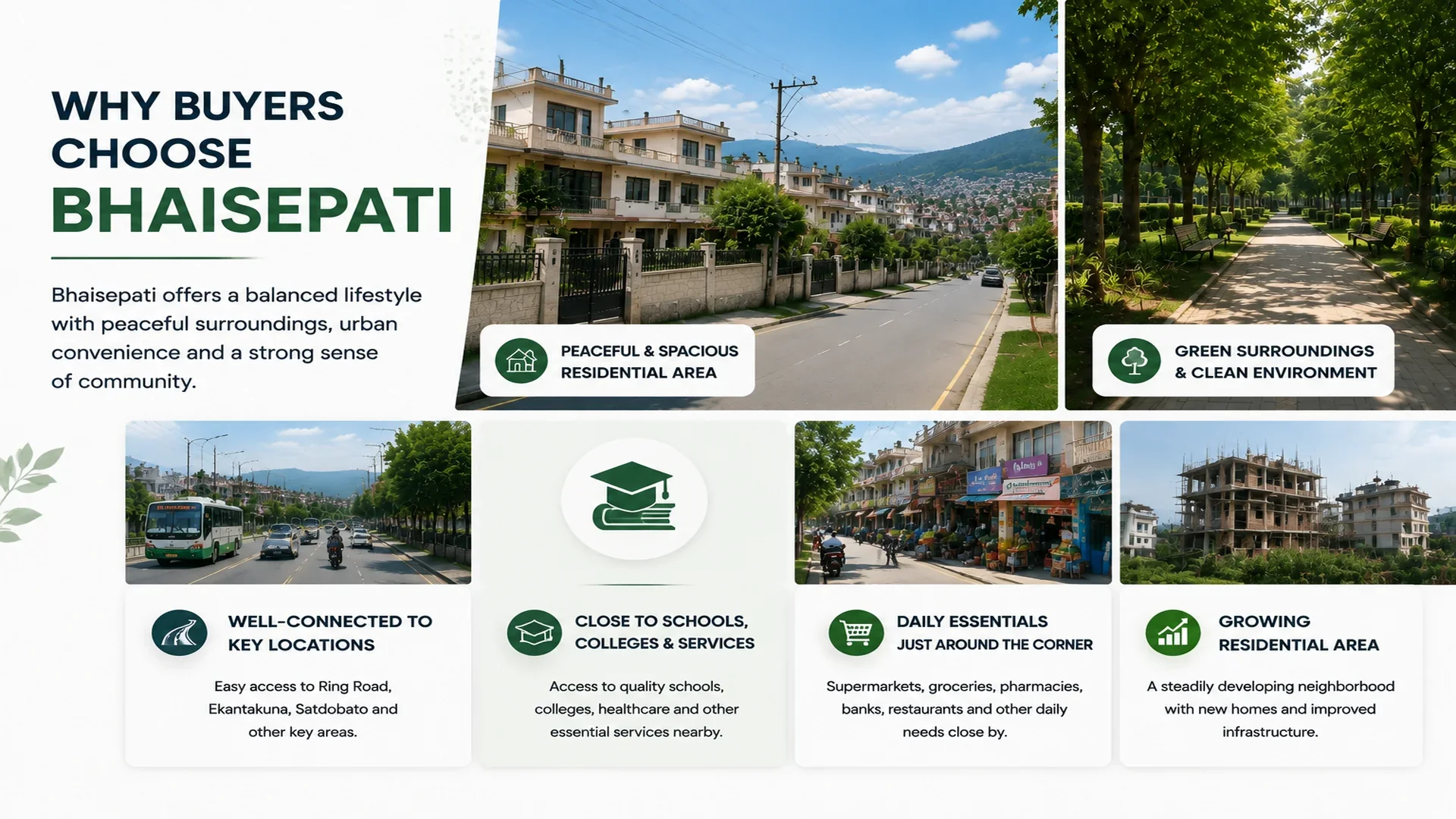
Bhaisepati is also known for several planned residential developments and housing colonies that have shaped the area’s identity among property buyers, contributing to its reputation as a planned residential zone rather than a purely organic settlement.
Several established residential developments, including Vinayak Colony, Gokul Awash, Reliable Colony, and Karyabinayak Homes, have contributed to Bhaisepati’s reputation as a planned residential area.
It’s worth noting that availability within any specific colony changes constantly — some developments, including sections of Vinayak Colony, have sold out entirely over time. These developments are best understood as reference points for the kind of housing environment Bhaisepati offers, rather than as an indication of current open inventory. For up-to-date availability, checking directly with a listing agent remains the most reliable approach.
Things to Check Before Buying Property in Bhaisepati
Whether you’re looking at a house or raw land in Bhaisepati, a few checks apply regardless of the specific property.
For land purchases, confirm the Lalpurja and ownership history match the seller’s claims, verify that the plot has documented and legally enforceable road access rather than relying on what looks usable on the ground, and request a Ghar Bato Sifaris where road access needs official confirmation from the ward office. Land classification — whether it’s registered for residential use — is also worth confirming before any advance payment changes hands.
For house purchases, the checks shift toward the physical structure and its paperwork: construction approval and an approved Naksa matching what’s actually built, visible structural condition including any cracks or dampness, water supply and storage capacity, electrical wiring condition, and parking access matching what’s advertised. Our house inspection checklist covers these points in more depth and is worth working through before paying any advance.
None of these checks are unique to Bhaisepati, but they matter just as much here as anywhere else in the Valley — skipping them is one of the more common causes of disputes and delayed transactions after the fact.
Is Bhaisepati a Good Property Investment?
Bhaisepati’s investment case rests mainly on steady residential demand rather than any dramatic growth story. The area continues to attract buyers priced out of central Lalitpur and Kathmandu who still want an organised, well-connected residential setting and more affordable land than they’d find closer to the city core, and both house and land transactions in the area have reflected that ongoing interest.
For buyers considering rental income, houses with separate rentable floors are common enough in the area to make this a realistic option, particularly given Bhaisepati’s appeal to families and working professionals who prefer a quieter residential setting over a central-city apartment. Land purchases tend to appeal more to buyers thinking in longer timeframes — building later, or holding a plot as the surrounding area continues to develop.
As with any property decision in Nepal, it’s worth being cautious of claims promising guaranteed appreciation or fixed returns — no one can responsibly predict property values years out. What can be said with more confidence is that Bhaisepati’s residential demand has remained steady and its infrastructure has continued to develop, making it a reasonable area for buyers to consider alongside other parts of southern Lalitpur.
Find Property in Bhaisepati with Punarvaasu Nepal
If you’re exploring a house or residential plot in Bhaisepati, Punarvaasu Nepal can help you move from browsing listings to an actual decision. Our team assists buyers with property evaluation, site visits, and the purchasing process, including document checks and registration once you’ve found the right property.
Looking for a house or land for sale in Bhaisepati? Explore available properties with Punarvaasu Nepal, or get in touch with our team directly for options that aren’t listed yet.
Frequently Asked Questions
Is Bhaisepati a good place to buy property?
For buyers prioritising space, a settled residential environment, and reasonable access to the Ring Road over a central-city address, Bhaisepati is generally a solid option. It suits families and long-term buyers better than those needing to be within walking distance of central Lalitpur or Kathmandu.
What types of properties are available in Bhaisepati?
The area offers a mix of standalone houses, bungalows, houses within organised colony developments, and residential land for those planning to build. Both smaller and larger plot sizes are available depending on budget.
Are there houses for sale in Bhaisepati?
Yes. Bhaisepati has an active resale and new-construction housing market, including homes within established colonies and standalone family houses on individual plots. Punarvaasu Nepal helps buyers explore available options in the area.
Is land available for sale in Bhaisepati?
Yes, residential plots are available in Bhaisepati, most commonly in the 4 to 6 aana range, with larger plots available depending on location and budget.
What should I check before buying property in Bhaisepati?
For land, confirm ownership documents, road access, and land classification, and request a Ghar Bato Sifaris where needed. For houses, check construction approval, structural condition, water and electrical systems, and parking access before paying any advance.
How much does land cost in Bhaisepati?
Prices vary depending on road access, plot size, location within Bhaisepati, and the development level of the surrounding area. Buyers should evaluate individual properties rather than relying on general averages — for a broader breakdown of pricing across Kathmandu Valley neighbourhoods, see our house price guide.

Join The Discussion