
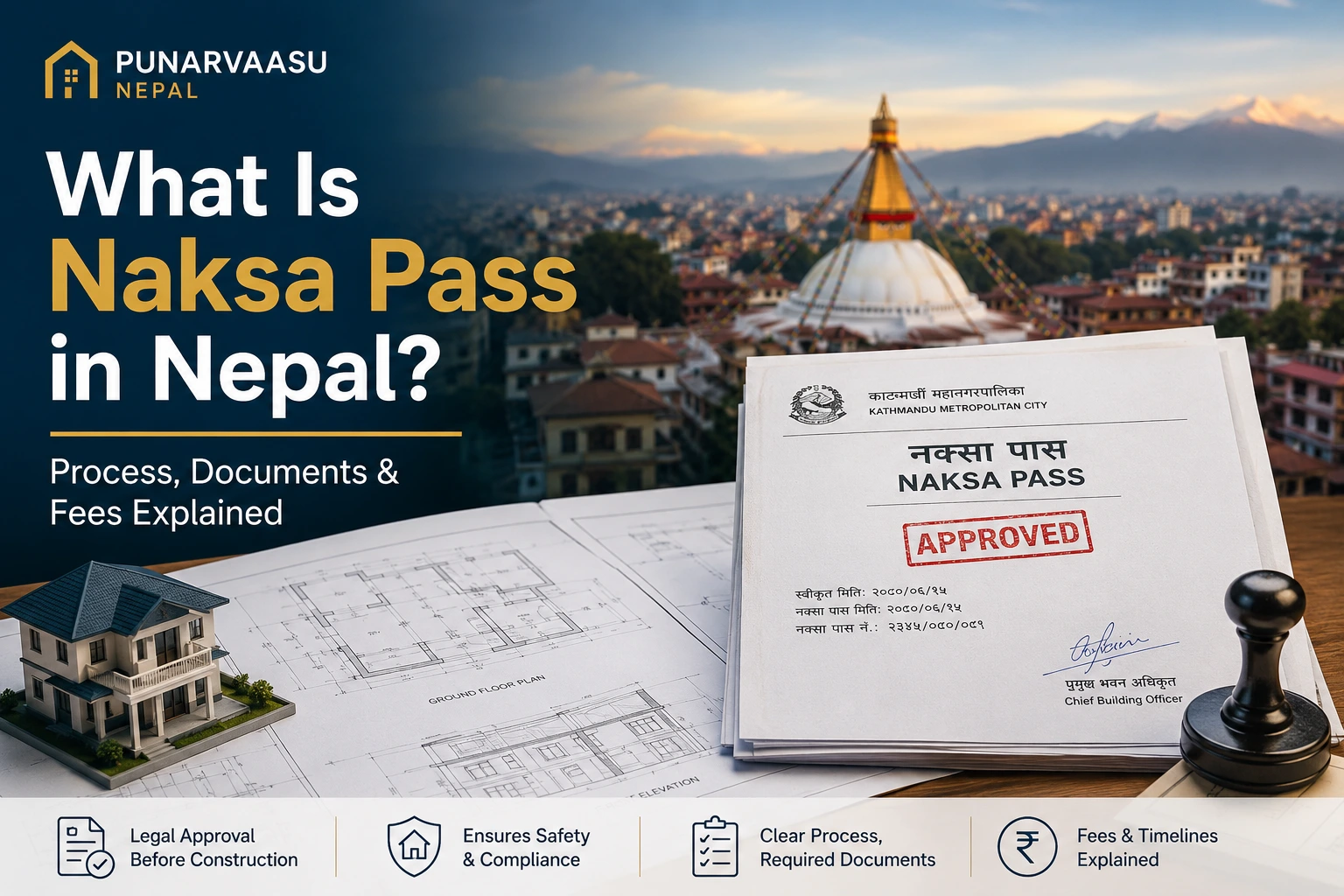
If you’re planning to build in Nepal, or even just buying property in Nepal with construction in mind, you’ve probably come across the term Naksa Pass. It’s a requirement many people are aware of, but few fully understand until they’re actually navigating the approval process — and overlooking it can have serious consequences. Building without one can mean fines, a stop-work order mid-construction, or in serious cases, demolition, and it can quietly follow a property into resale years later. Here’s what Naksa Pass actually is, what it takes to get one, and why it should matter to you even if you never plan to lift a shovel yourself.
What Is Naksa Pass?
Naksa Pass is the municipal approval required before any new building can legally be constructed in Nepal. “Naksa” refers to the architectural design or blueprint, and “Pass” means the design has been reviewed and approved by the government. It confirms that your building plan follows local zoning rules, road setback requirements, height limits, and Nepal’s National Building Code.
It’s worth separating this from another term you may see on property documents: the Naksa, or trace map, which shows a plot’s boundaries and kitta number for ownership and verification purposes — covered in more detail in our guide to verifying land in Nepal. That’s a different document used to confirm what land you own. Naksa Pass, by contrast, is permission for what you’re allowed to build on it.
Why Naksa Pass in Nepal Is Mandatory
Naksa Pass isn’t a formality you can skip if you’re in a hurry. It’s a legal requirement under Nepal’s Building Act 2055, which gives municipalities the authority to regulate construction and take action against unauthorized building. Since Nepal sits in an active earthquake zone, this approval process also exists to confirm that your design meets the seismic safety standards set out in the National Building Code before anything gets built.
Beyond the immediate penalties, an unapproved structure creates lasting problems: it can’t be legally used as collateral for a loan, it complicates insurance, and it becomes a liability the moment you try to sell.
Documents You’ll Need
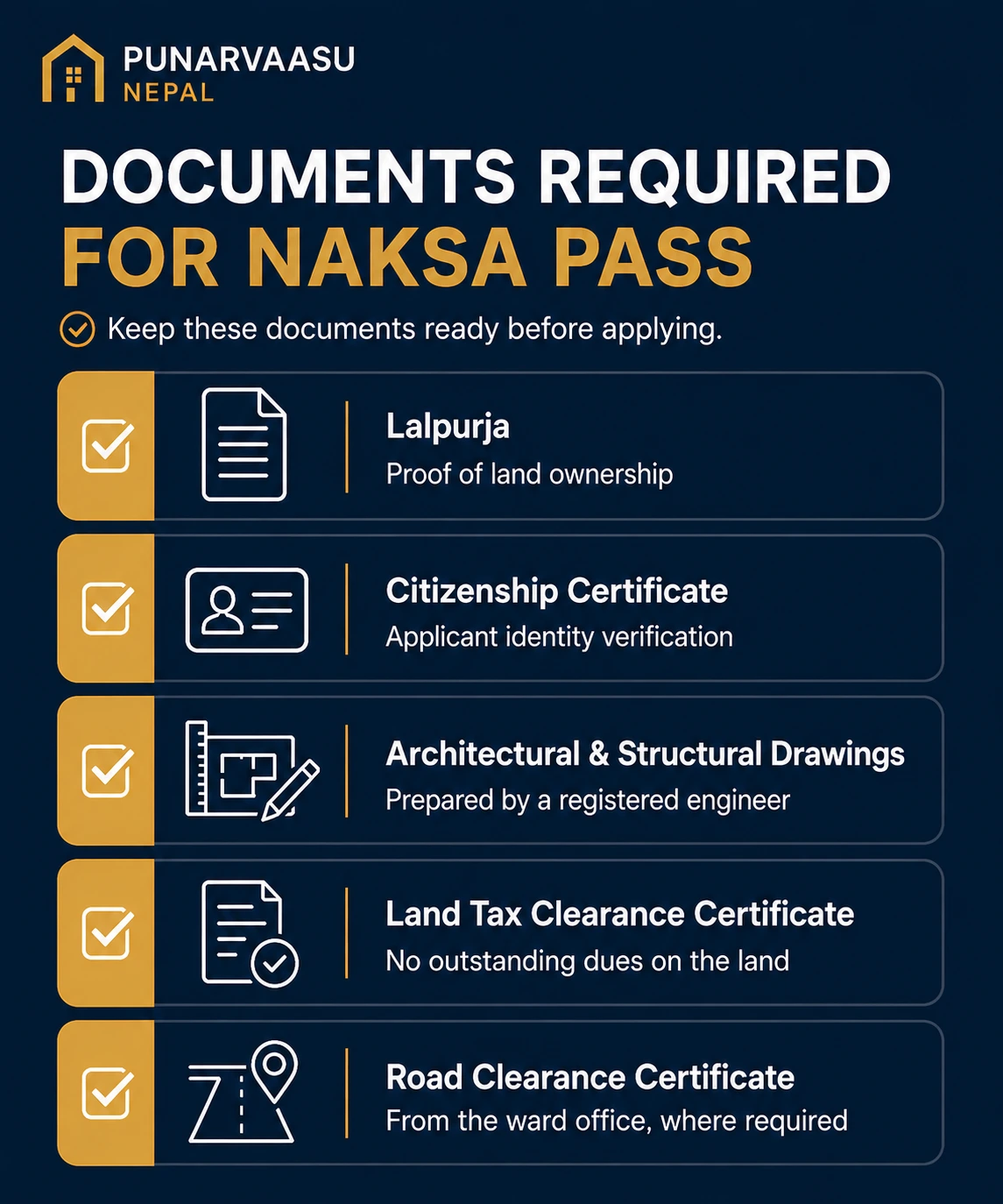
Requirements can vary slightly by municipality, but most applications ask for the same core set (see our full breakdown of documents needed to buy or sell property in Nepal for how these fit into the broader transaction):
- Lalpurja (land ownership certificate), proving you own the plot you intend to build on
- Citizenship certificate, confirming your identity and eligibility
- Architectural and structural drawings, prepared and signed by a registered engineer or architect
- Land tax clearance certificate, showing no outstanding dues against the land
- Road clearance certificate from your ward office, if required for the specific site
Missing or incomplete documents are one of the most common reasons applications get delayed, so it’s worth confirming the exact list with your ward office before submitting.
The Naksa Pass Process, Step by Step
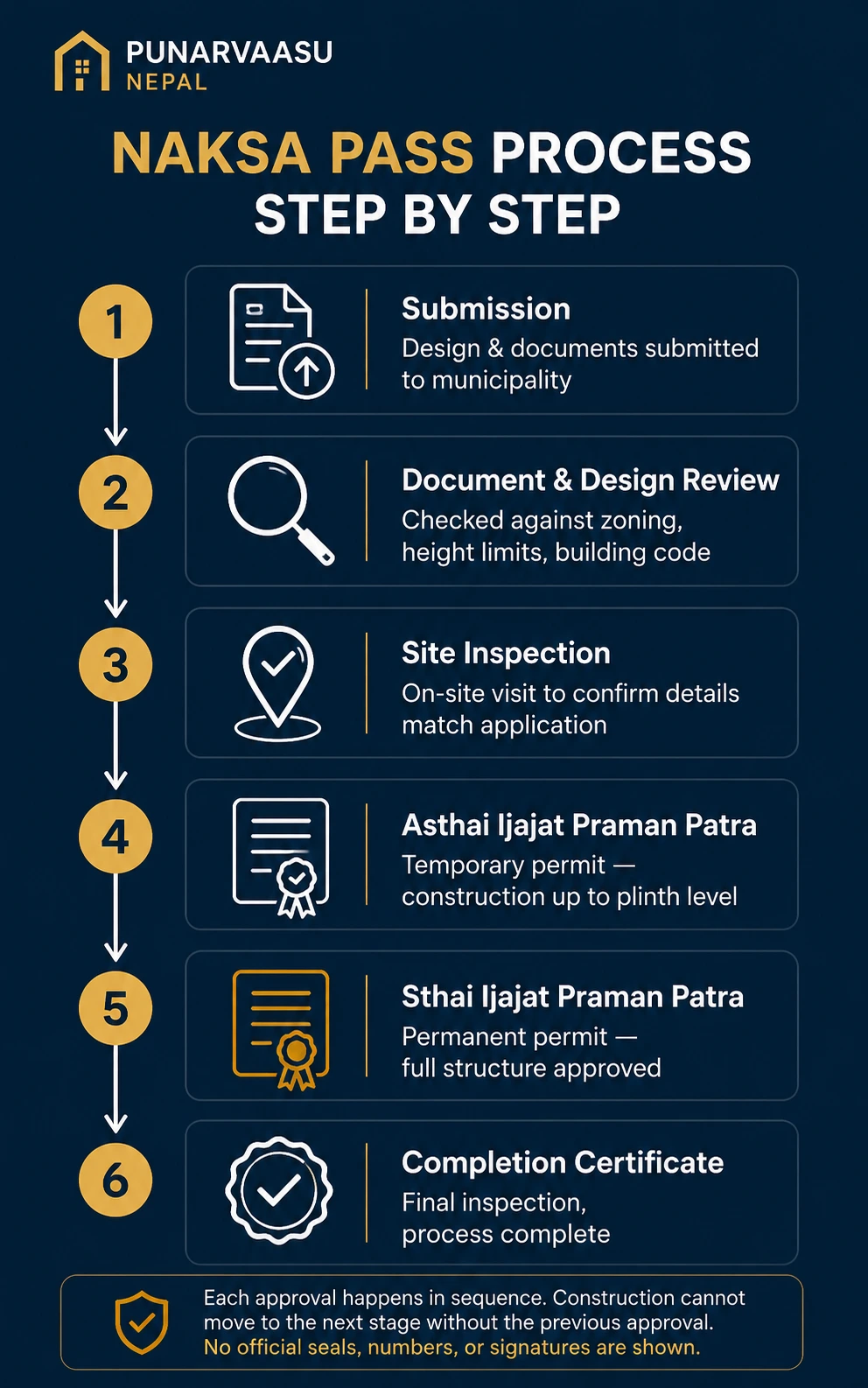
Getting a Naksa Pass isn’t a single approval — it happens in stages, each tied to a phase of construction.
1. Submission. You submit your design and supporting documents to the municipality or rural municipality office, under building bylaws set by the Ministry of Urban Development. Many local bodies now accept applications through an Electronic Building Permit System — Kathmandu Metropolitan City runs its own Electronic Building Permit System, and Lalitpur Metropolitan City operates a parallel eBPS platform — which has made tracking and processing faster and more transparent than the older paper-based process.
2. Document and design review. Municipal officials check that your plan complies with zoning rules, building codes, and any restrictions specific to your ward, such as height limits or plot-size minimums. For residential construction, most municipalities require a minimum plot size of around 2.8 aana, though this varies by area.
3. Site inspection. Once your documents clear review, an inspection team visits the site to confirm what’s on paper matches what’s on the ground.
4. Asthai Ijajat Praman Patra (Temporary Permit). This is issued after your initial approval and allows construction up to plinth level — the foundation and ground floor base. You cannot legally build beyond this point without the next stage of approval.
5. Sthai Ijajat Praman Patra (Permanent Permit). After a second inspection confirms your plinth-level work matches the approved design, you receive this permit, which clears you to complete the full structure.
6. Completion Certificate. Once construction is finished, a final inspection is carried out and this certificate is issued, formally closing out the process.
How Long Does It Take?
There’s no fixed timeline that applies everywhere; it depends on your municipality’s processing backlog and how complete your documentation is on first submission. As a general range, approval typically takes 30 to 90 days depending on the municipality and project complexity. Kathmandu Metropolitan City processes applications through the Electronic Building Permit System (eBPS), which has brought online submission and tracking to the process and can move faster, often within 25 to 30 days, for complete applications with no design conflicts. Engaging a registered engineer familiar with your local municipality’s specific requirements is one of the more reliable ways to avoid delays.
Common Mistakes That Delay Approval
Most delays trace back to a small set of avoidable issues:
- Documents that don’t match across the application — a common example is a Lalpurja name that doesn’t exactly match the citizenship certificate, or a land tax clearance that’s expired by the time of submission
- Design non-compliance, such as exceeding height limits, ignoring road setback requirements, or a plot that doesn’t meet the minimum size threshold for the area
- Using an unregistered engineer or architect, whose drawings municipalities may reject outright regardless of design quality
- Starting construction before receiving the Asthai Ijajat Praman Patra, which can trigger a stop-work order even if the final design would have been approved
- Skipping the plinth-level inspection before continuing construction, which delays the Sthai Ijajat Praman Patra and can require costly rework if anything doesn’t match the approved plan
Working with a registered engineer who has handled applications in your specific municipality is the most reliable way to avoid all five.
Fees
Naksa Pass fees are typically charged per square foot of built area and vary by municipality and property use. As a general range, residential buildings tend to fall between NPR 10 and 25 per square foot, while commercial buildings can run up to NPR 45 per square foot. Location, land use classification, and building size can all affect where you land within that range, so it’s worth confirming current rates with your specific ward office before budgeting.
What Affects the Fee
A few factors determine where your project falls within that range:
- Municipality. Kathmandu Metropolitan City, other municipalities, and rural municipalities each set their own fee schedules, so the same house can cost differently depending on where it’s built.
- Residential vs. commercial use. Commercial buildings are charged at a higher rate than residential ones, reflecting the larger scale and stricter compliance requirements typically involved.
- Total built-up area. Since fees are charged per square foot, a larger design, or one with more floors, means a proportionally higher total fee.
- Revised plans. If you change your design after initial approval, whether to add floor area or alter the structure, most municipalities charge an additional fee to review and approve the revision. Planning your design carefully before submission avoids paying for the same approval twice.
Why Naksa Pass Matters Even If You’re Not the One Building
Most guides to this process are written for people about to construct a building.Whether you’re buying an existing home or land for future development, make checking the property’s Naksa Pass part of your pre-purchase due diligence instead of leaving it until after the deal is complete.
For land, this means confirming that any future construction won’t run into plot-size or zoning restrictions you weren’t aware of. For an already-built house, it means asking the seller for a copy of the Naksa Pass and Completion Certificate alongside the Lalpurja.If a building was constructed without an approved Naksa Pass, or differs from the design that was approved, the legal and financial liabilities become the responsibility of the new owner after the sale. Those issues remain attached to the property and can continue to affect future transactions.
It also affects resale value directly. Buyers increasingly ask for this documentation, and a property that can’t produce it is harder to sell, harder to use as loan collateral, and harder to insure. If you’re evaluating a property and the Naksa Pass documentation isn’t readily available, that’s worth treating as a serious flag rather than a minor paperwork gap.
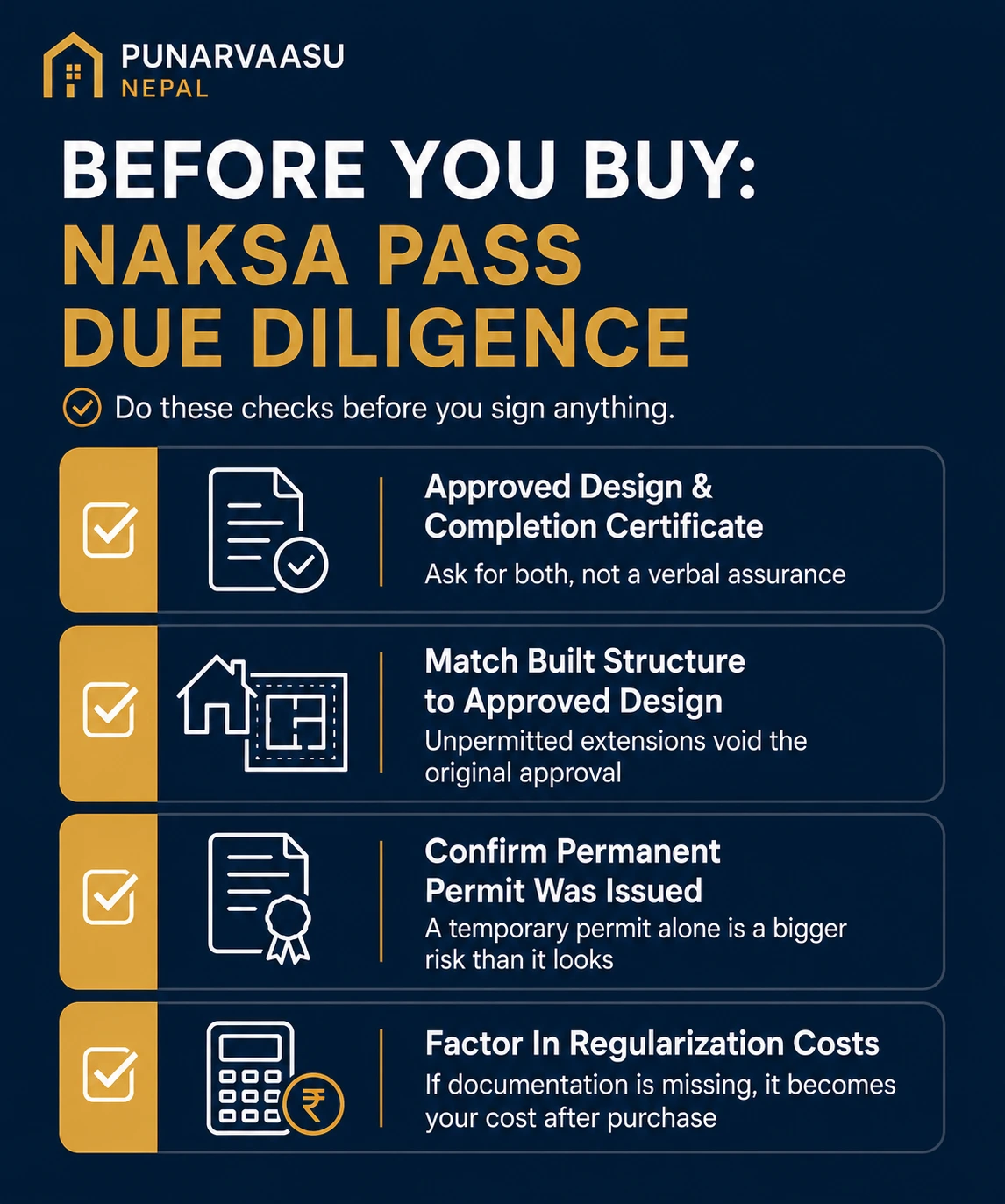
When you’re doing due diligence on a property, treat Naksa Pass as its own checklist item, separate from the Lalpurja review:
- Ask for the approved design and the Completion Certificate, not just a verbal confirmation that “everything is legal”
- Check that the completed building matches the approved plans. Unauthorized extensions or additional floors are relatively common and can invalidate the original approval.
- Check whether the Sthai Ijajat Praman Patra was actually issued, not just the temporary plinth-level permit — a house built and sold on a temporary permit alone is a bigger risk than it looks
- If anything is missing, factor the cost and time of regularizing it into your offer, since resolving it after purchase becomes your responsibility, not the seller’s
Before You Build or Buy
Naksa Pass isn’t just paperwork — it’s proof that a property has been approved for legal and safe construction. Whether you’re buying or building, verifying it can save you from expensive legal problems later. If you’re planning to build, start the process early and work with a registered engineer who knows your municipality’s requirements. If you’re purchasing a property, include Naksa Pass documentation in your due diligence alongside the Lalpurja and land tax clearance certificate.
Naksa Pass is one piece of a larger picture — pair this with our guide on property valuation in Nepal and the land verification guide linked above to build a full due-diligence checklist before you buy, sell, or build.
You can verify with the local ward office whether a Naksa Pass was issued for the property, and the seller should also be able to provide a copy of the approved building plans. See the due-diligence checklist above for what to compare it against.
Frequently Asked Questions
Is Naksa Pass mandatory for all buildings in Nepal?
Yes, with no exception for size — a one-room structure and a large commercial building both require it, though the documentation and fees scale with the project.
Can I sell a house that doesn’t have Naksa Pass?
Legally, this creates significant complications. A structure without an approved Naksa Pass and Completion Certificate is harder to transfer cleanly, harder to finance for the buyer, and may require regularization before a sale can proceed smoothly.
What’s the difference between Naksa and Naksa Pass?
They’re easy to confuse but serve opposite purposes: one confirms what land you own, the other confirms what you’re allowed to build on it. The Naksa (trace map) shows a plot’s ownership boundaries; Naksa Pass approves the construction design itself.
Do I need Naksa Pass for renovations, or only new construction?
Significant renovations, particularly those adding floor area or structural changes, generally require approval as well. Minor interior work typically does not, but it’s worth confirming with your ward office before starting any renovation involving structural changes.
How do I check if an existing house has a valid Naksa Pass?
You can verify with the local ward office whether a Naksa Pass was issued for the property, and the seller should also be able to provide a copy of the approved building plans. See the due-diligence checklist above for what to compare it against.

Join The Discussion