
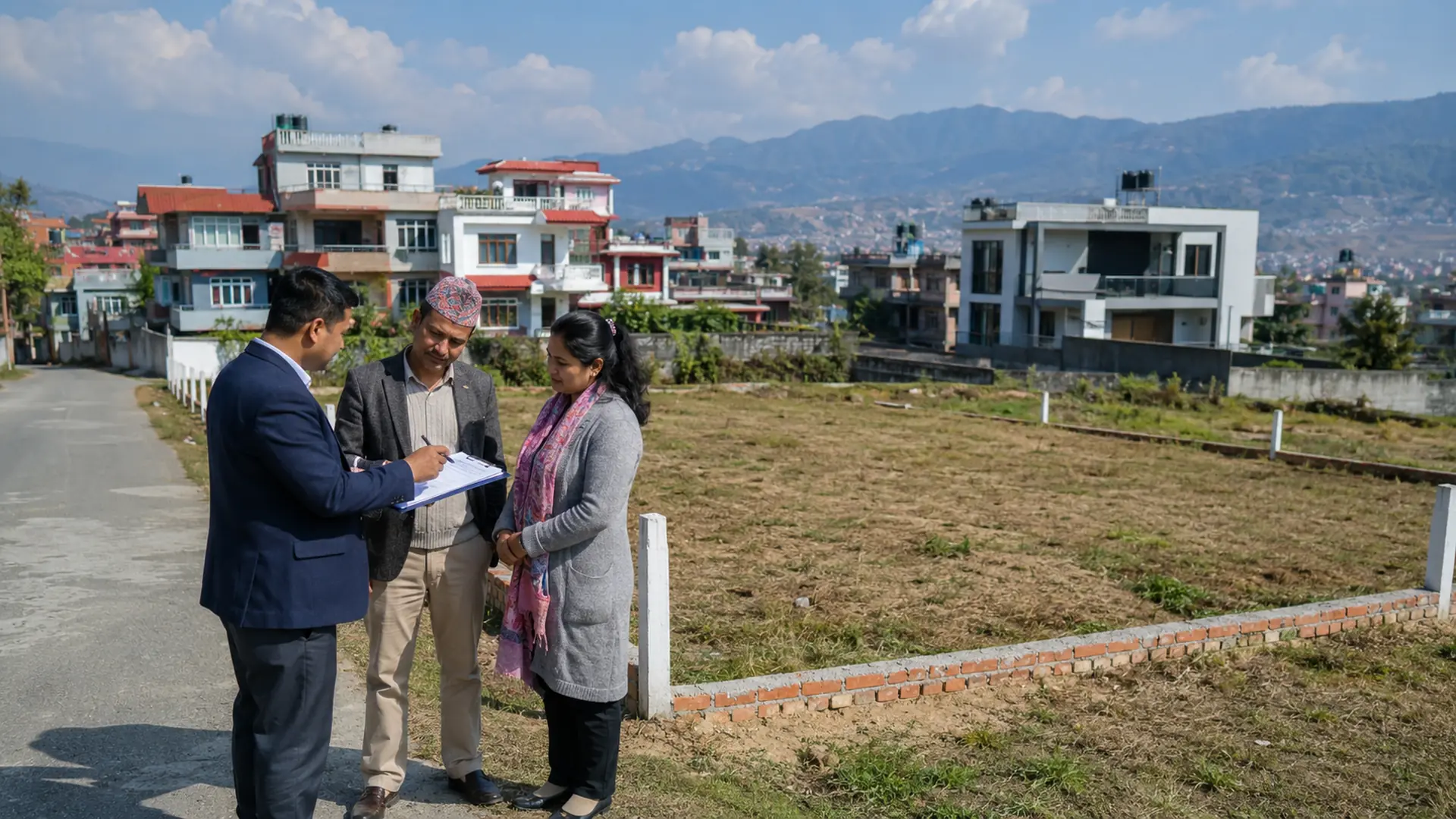
Selling land in Nepal involves far more than finding a willing buyer. Before any advertisement goes out, the seller needs to confirm ownership, gather the right documents, set a realistic price, negotiate safely, and complete the ownership transfer through the correct government office. Skipping any of these stages is a common cause of delays, disputes, and failed sales. Landowners can also work with Punarvaasu Nepal to prepare property details, reach potential buyers, and coordinate site visits, so the process stays organized from listing to registration. This guide walks through each stage in order, from checking whether the land is actually ready to sell through to the final transfer of ownership.
How to Sell Land in Nepal: Quick Overview
For readers who want the process at a glance, here are the core stages involved in selling land in Nepal:
- Confirm ownership and selling authority.
- Resolve any legal, family, or loan-related issues.
- Prepare the required documents.
- Estimate the land’s market value and set an asking price.
- Prepare accurate listing information and market the land.
- Screen buyers and negotiate the terms.
- Sign a written agreement.
- Complete payment, tax payment, and ownership transfer.
The section below walks through these same stages as a detailed eight-step process.
Check Whether the Land Is Ready to Be Sold
Before any marketing begins, it’s worth confirming that the land can actually be sold without complications. Rushing this step is one of the most common reasons sales fall through midway. For a fuller walkthrough of ownership and document checks from a buyer’s perspective — which is worth understanding since it shows what the other side of your sale will be checking — see How to Verify Land in Nepal.
Confirm the registered owner. The seller’s identity and ownership details should be consistent across the Lalpurja, citizenship certificate, and official land records. Any name difference or other inconsistency should be resolved with the relevant Land Revenue Office before the land is marketed, rather than discovered midway through a sale.
Check for loans, disputes, or restrictions. Land carrying an active mortgage, a court dispute, a boundary disagreement, unpaid taxes, or a government restriction generally cannot be transferred until the issue is resolved. Road or access disputes are also worth checking early, since they tend to surface during a buyer’s own due diligence. See Common Real Estate Disputes in Nepal for a fuller look at how these situations typically arise and get resolved.
Confirm the authority of every owner. A single co-owner generally cannot sell an entire jointly owned plot without the participation or valid consent of the other registered owners. Transferring a clearly defined ownership share, rather than the whole plot, may follow a different procedure, so it’s worth confirming with the Land Revenue Office or a property lawyer beforehand. The same applies to inherited land that hasn’t yet been through Jagga Namsari — see Jagga Namsari in Nepal if the land is still registered under a previous owner’s name — and if any owner lives outside Nepal, a valid power of attorney should be arranged well in advance.
Documents Required to Sell Land in Nepal
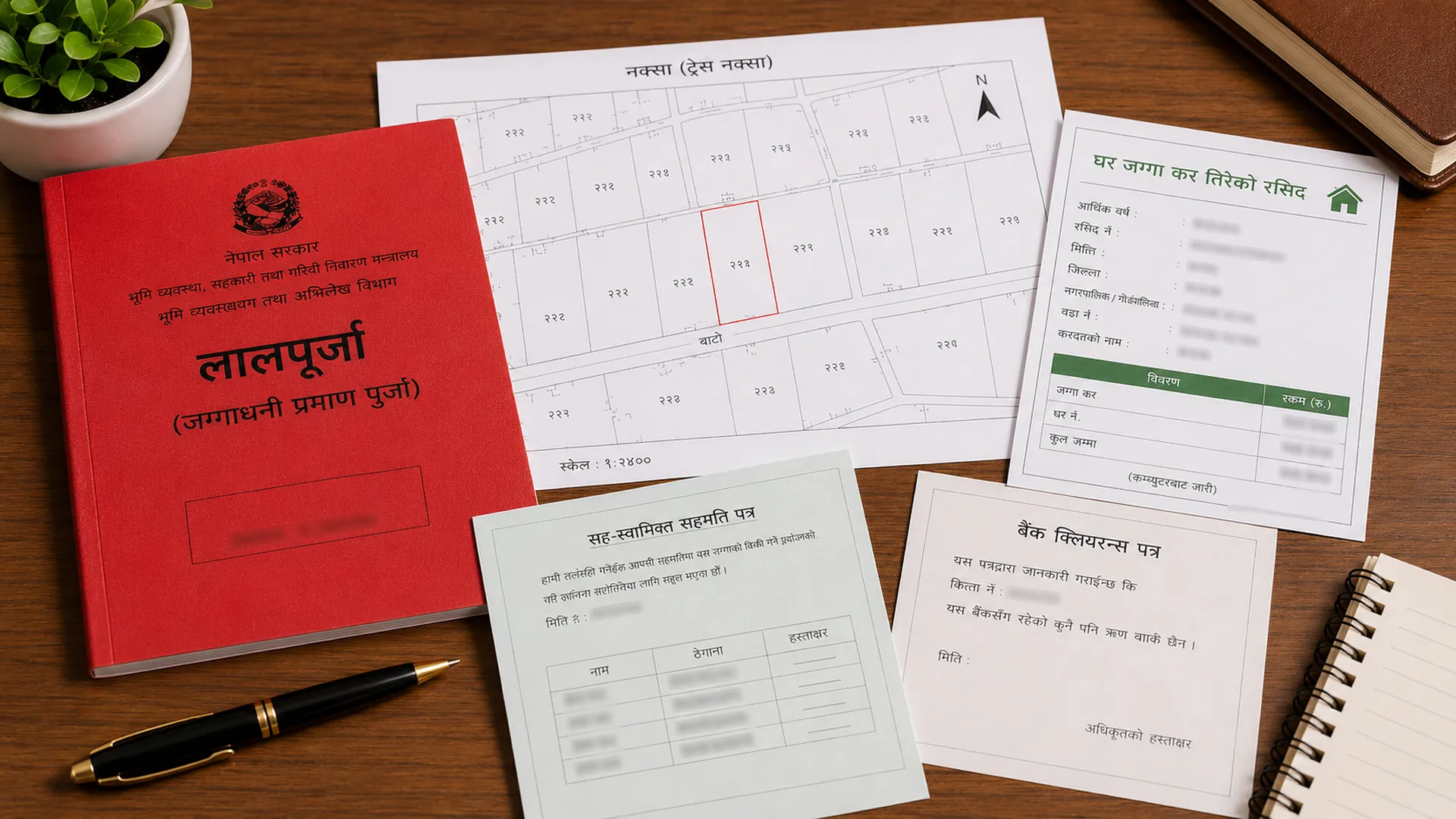
Having documents ready before listing the land saves weeks of back-and-forth once a buyer is interested. Commonly requested documents include:
- Original Lalpurja — the land ownership certificate.
- Seller’s citizenship certificate — should match the name on the ownership record.
- Recent land-tax payment receipt — confirms taxes are current.
- Trace map or cadastral map, when required by the Land Revenue Office for the specific plot. Copies can be obtained through the Survey Department’s Mero Kitta online portal or the relevant survey office.
- Consent from co-owners, where the land is jointly or family-owned.
- Namsari documents, if the land was transferred through inheritance.
- Power of attorney, if the registered owner cannot appear in person.
- Bank clearance, if the land is currently mortgaged.
The exact checklist can change depending on co-ownership, inheritance, mortgage status, and the specific Land Revenue Office handling the transfer. Punarvaasu Nepal’s team can help confirm the current document requirements for your specific situation before you list.
Step-by-Step Land Selling Process in Nepal
Step 1 — Determine the Land’s Realistic Market Value
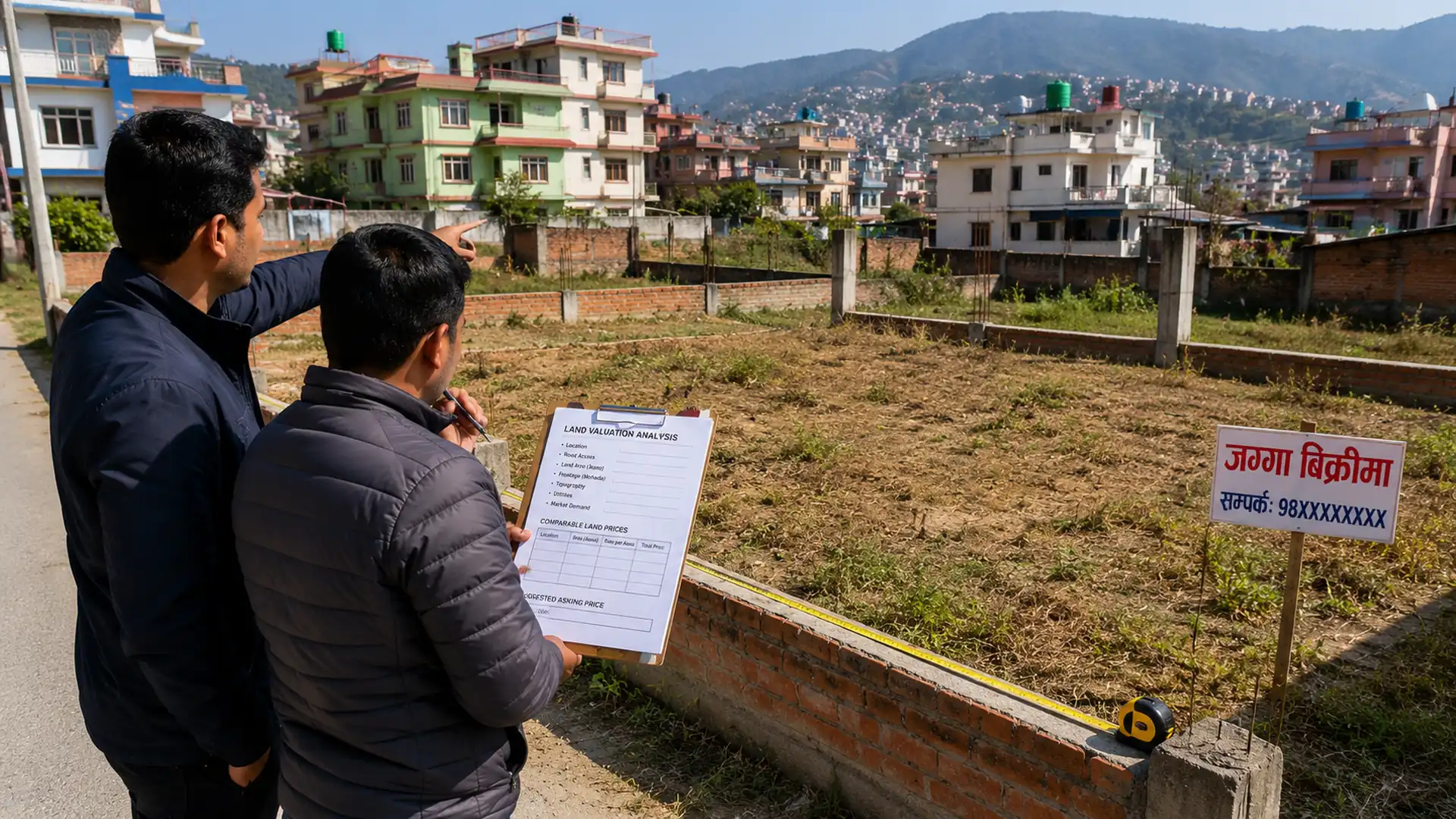
Land value in Nepal depends on a combination of factors: location, road access, plot shape, frontage (mohada), total size, permitted zoning and land use, proximity to nearby facilities, and recent sale prices of comparable plots in the same area. It’s also worth understanding the difference between the government-assessed valuation, used for tax purposes, and the market rate, which reflects what buyers are realistically willing to pay. For a closer look at how these factors are weighed, see Property Valuation in Nepal. Relying on outdated comparisons or a single broker’s opinion often leads to a price that doesn’t match what buyers are actually paying.
Step 2 — Set an Asking Price
It helps to separate three numbers before listing: the price you’d ideally like, a realistic asking price based on comparable sales, and the minimum you’re willing to accept. Pricing based on rumours, neighbours’ asking prices, or unverified claims about the area’s growth potential tends to either scare off serious buyers or leave the land sitting unsold for months.
Step 3 — Prepare Accurate Land Information
Buyers tend to respond better when a listing gives them something concrete to evaluate rather than vague description. That means stating the specific location, the total plot size, how wide the access road is, which direction the plot faces, the kitta number, the shape of the plot, what’s nearby, and what the land is realistically suited for. Clear, recent photographs and video walkthroughs help buyers decide early whether the land suits them, saving time before a visit is even scheduled.
Step 4 — Market the Land and Find Buyers
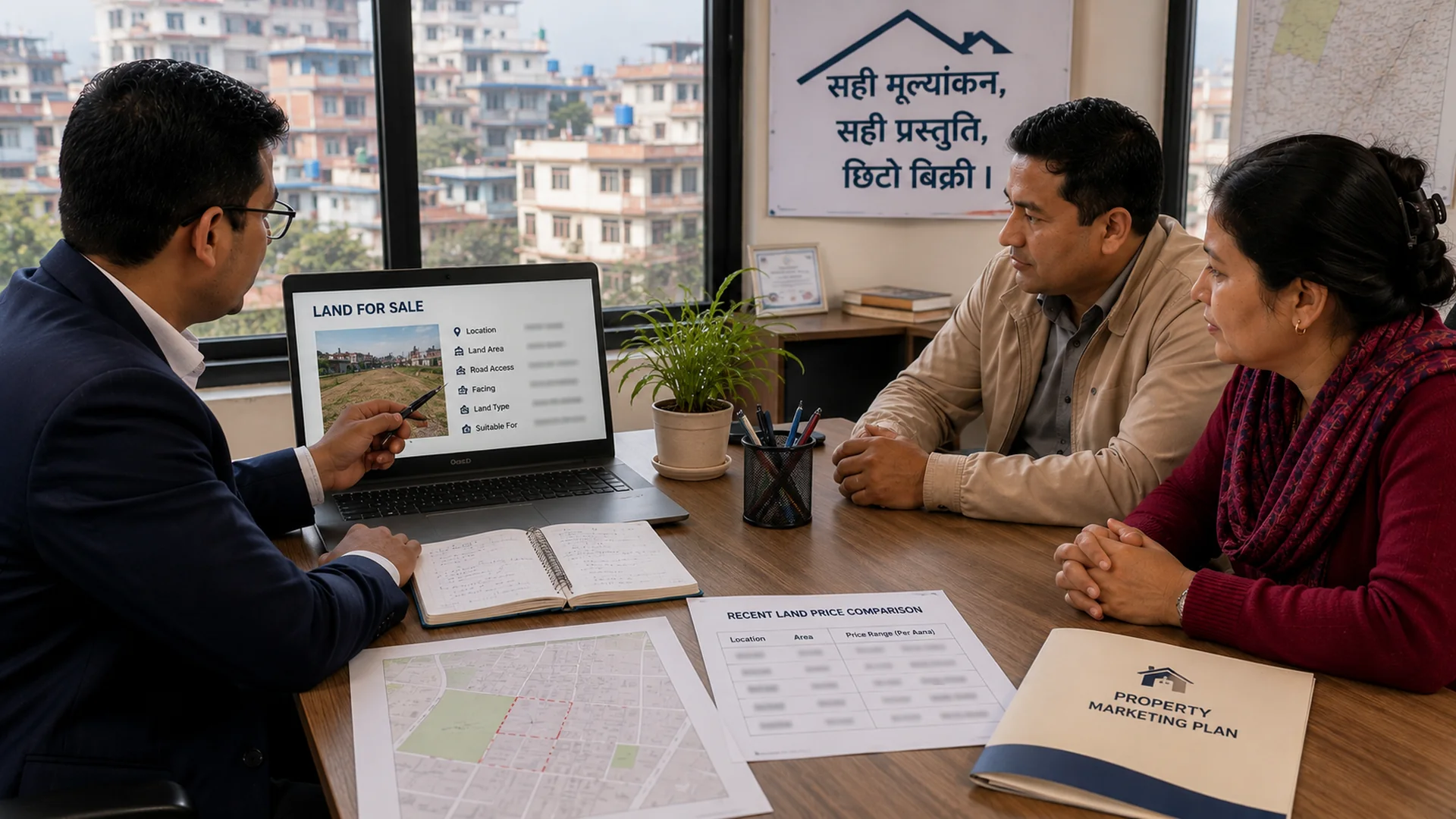
Most sellers combine a few channels: property listing platforms, real estate agencies, local brokers, social media, referral networks, and, where appropriate, a signboard on the land itself. Listings built around accurate, complete details consistently generate better-quality inquiries than vague ones.
Step 5 — Screen Inquiries and Arrange Site Visits
Not every inquiry is a serious one. Before scheduling a visit, it helps to gauge whether the buyer has a realistic ability to complete the purchase. Sellers should allow serious buyers, or their legal representatives, to inspect the original ownership documents during due diligence — that’s a normal, expected part of the process. Original documents should remain with the seller. Serious buyers or their representatives may inspect them, while clearly labelled copies can be provided when verification is necessary. During visits, being upfront about access routes and boundaries builds trust, since problems are easier to disclose early than to explain after an agreement is signed. It is also useful to keep a basic log of site visits, buyer details, and any offers received during the process.
Step 6 — Negotiate the Price and Payment Terms
The final price is only one piece of what actually gets decided during negotiation. A buyer pushing hard on price may be more flexible on the payment schedule or registration date, and vice versa — it helps to know which of these you’re willing to trade before the conversation starts. Be cautious of pressure to agree verbally to terms “for now” with the details to be sorted out later; anything agreed at this stage should move directly into the written Bayana covered in Step 7, not linger as an informal understanding. If a buyer resists putting agreed terms in writing, that’s usually a sign to slow down rather than proceed.
Step 7 — Prepare a Written Bayana or Sale Agreement
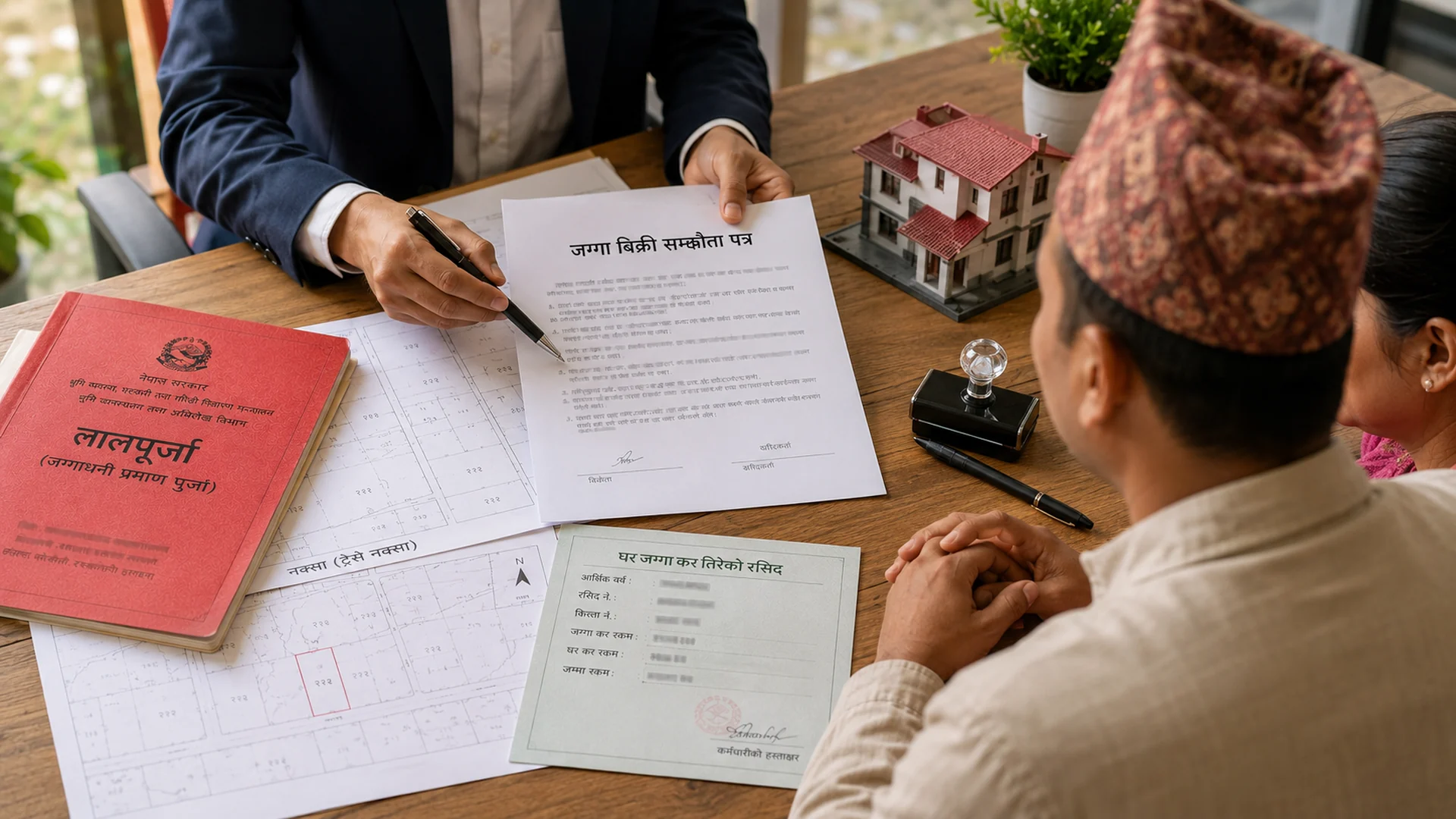
Once terms are settled, they belong in a written Bayana agreement — this is the checklist that document should cover:
- The identity of both buyer and seller
- Complete land information should be consistent with both the Lalpurja and the official trace map.
- The agreed price and the advance payment amount
- The payment schedule and final payment date
- The target registration date
- How Taxes and Transaction Costs Are Divided
- Any conditions that must be completed before the transfer goes through
- Terms for refund or cancellation if the deal falls through
This is a standard part of the process, but the terms should be reviewed by a lawyer or a trusted real estate professional rather than treated as a standard template — every sale has different conditions worth accounting for.
Step 8 — Complete Payment and Ownership Transfer
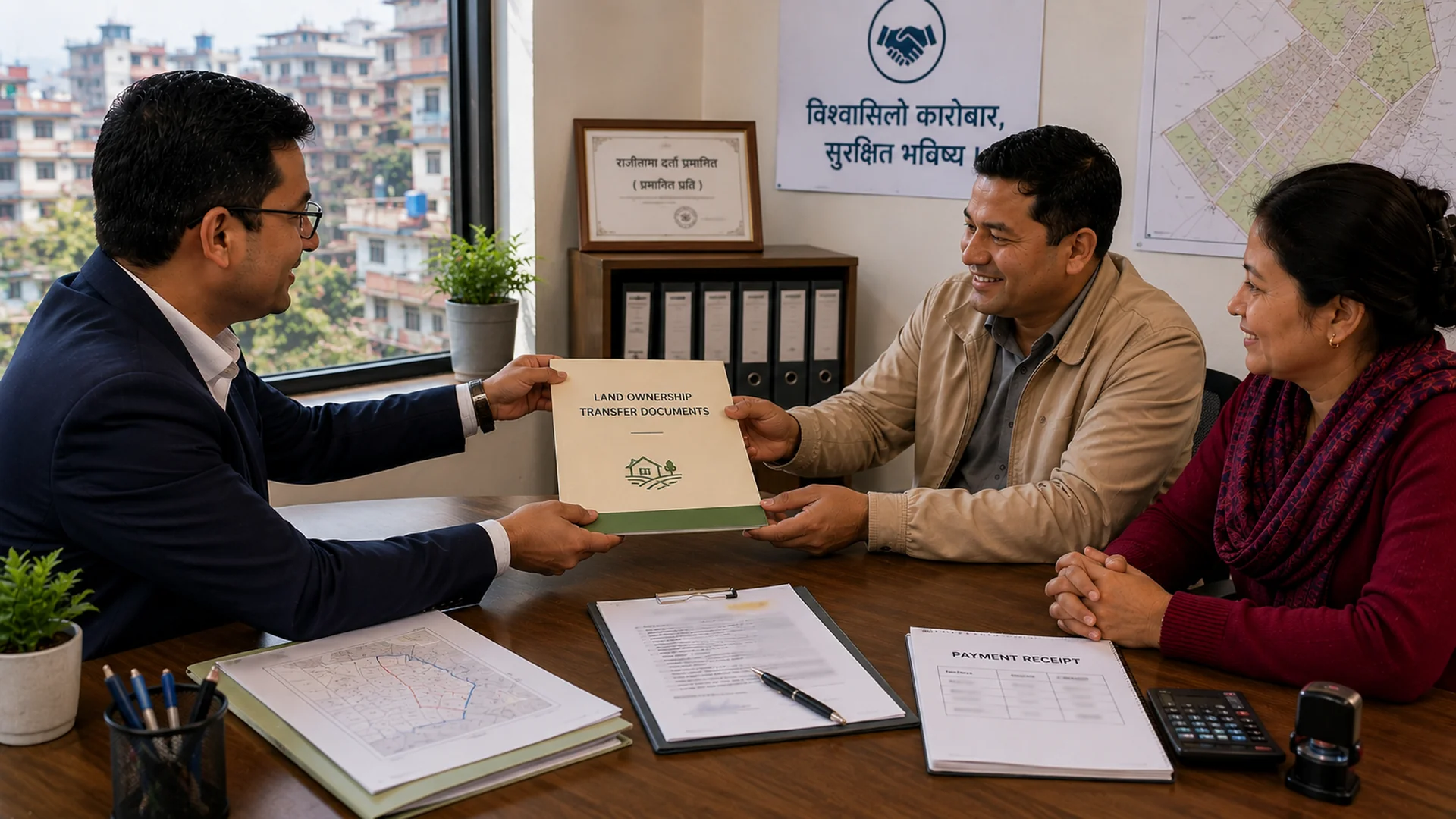
This is the most important stage of the process, and it’s worth understanding as a sequence rather than a single event.
The Bayana signed in Step 7 is preliminary — it sets out intent and terms but doesn’t transfer ownership. That happens through the final transfer deed, or Rajinama, registered at the relevant Land Revenue Office. Before registration, both parties’ identity and ownership documents are verified against official records, and any outstanding taxes or dues are confirmed as cleared. Full payment should be confirmed as received — not merely promised or scheduled — before the Rajinama is signed and the transfer is registered; sellers should avoid proceeding to registration on the basis of a pending or partial payment. Once the Rajinama is signed and registered, ownership transfers into the buyer’s name, and both parties should keep copies of the signed deed and payment receipts. Procedures and document requirements can differ by transaction and office, so it’s worth confirming the current checklist before the registration date is set.
As with the readiness check earlier, mortgaged land can still go through this process — the lender is typically involved so the loan can be settled and the mortgage released, or bank clearance completed, as part of the same transaction.
Expenses and Tax Obligations for Land Sellers in Nepal
Selling land comes with its own set of costs, separate from what buyers pay, and it’s worth distinguishing national from local charges. Capital gains tax is a national tax governed by the Income Tax Act, administered by the Inland Revenue Department, and the applicable rate can change through national tax legislation, so it’s worth confirming the current position directly before finalizing a sale. Registration charges, local taxes, and administrative fees, by contrast, vary by province, municipality, and fiscal year. Sellers also typically account for documentation expenses, brokerage fees where applicable, legal fees, and costs tied to maps or valuation. For a more detailed explanation of the taxes, registration charges, and payment responsibilities involved, read our guide to, property tax rules for buyers and sellers in Nepal.
How Long Does It Take to Sell Land in Nepal?
There’s no fixed timeline for selling land in Nepal — the process can move quickly or take considerably longer depending on the situation. Asking price, location, road access, how complete your documents are, current buyer demand in the area, any legal complications, outstanding loan clearance, the number of owners involved, and the quality of your marketing all play a role. As a general pattern rather than a promise: land that’s realistically priced with clean, ready documents and no co-ownership or dispute issues tends to attract serious offers noticeably faster than land where any of those are still being sorted out once a buyer is already interested — the delay usually comes from resolving something after the fact rather than from finding a buyer in the first place.
Common Mistakes to Avoid When Selling Land
Setting an unrealistic price. Some landowners set their price using local hearsay or an unusually high estimate from a broker instead of checking recent sales of similar plots. An inflated price often keeps land unsold for months and discourages the serious buyers who would otherwise move quickly.
Marketing without complete details. Listings that leave out road access, exact size, or zoning information generate more time-wasting inquiries and fewer serious ones.
Hiding access or boundary problems. Issues like disputed boundaries or limited road access tend to surface during a buyer’s own verification. Disclosing them upfront is far less costly than having a deal collapse after months of negotiation.
Accepting undocumented payments or signing an unclear advance agreement. Any payment, including an advance, should be backed by a written Bayana that specifies refund terms, deadlines, and each party’s responsibilities. A verbal understanding is difficult to enforce and offers little protection if a dispute arises later.
Ignoring co-owner approval or known legal complications. Selling jointly owned or family land without valid consent from every owner can prevent or invalidate the transfer, and unresolved disputes rarely stay hidden once a buyer starts their own checks.
Sharing original documents too early. Originals should stay with the seller until a buyer shows genuine, verified intent — inspection is normal, but the documents shouldn’t leave the seller’s possession before that point.
Depending on a single broker. Relying on one contact limits buyer reach and leaves fewer options during negotiation.
Transferring ownership before confirming full payment. Once land is registered in the buyer’s name, a seller has few options left if the remaining payment doesn’t come through.
Should You Sell Land Privately or Through a Real Estate Company?
Selling privately gives you direct control over communication and negotiation, and it avoids agency fees. But it also means a smaller buyer network, more time spent on unqualified inquiries, more uncertainty around pricing, and managing document verification without professional support — all of which can extend the time it takes to close.
Working with a real estate company typically means professional listing preparation, more thorough buyer screening, wider exposure to buyers, coordinated site visits, and guidance through each stage of the transfer. For sellers without the time or experience to manage the process themselves, this support can make the process considerably more efficient, though outcomes still depend on the property, the market, and how ready the seller’s documents are.
Frequently Asked Questions
What documents are required to sell land in Nepal?
Commonly requested documents include the original Lalpurja, a citizenship certificate, and a recent tax payment receipt. Depending on the situation, a trace map, co-owner consent, Namsari documents, power of attorney, or bank clearance may also be required.
Can inherited land be sold in Nepal?
Yes, once the land has been formally transferred into the heir’s name through the Namsari process and the relevant documents are updated at the Land Revenue Office, it can generally be sold like any other registered property.
Can jointly owned land be sold by one owner?
A single co-owner generally cannot sell the entire plot without the participation or valid consent of the other registered owners. Transferring a clearly defined personal share may follow a different procedure — it’s worth confirming the applicable process with the Land Revenue Office or a property lawyer.
Can mortgaged land be sold?
Yes, but the lender is normally involved so the loan can be settled and the mortgage released, or the required bank clearance completed, as part of the transaction.
Who pays the taxes and registration fees?
The seller usually handles any capital gains tax that applies, while the buyer commonly covers the charges for registering the land under the new ownership. The parties may negotiate other transaction expenses between themselves, but each side’s legal obligations are worth confirming before registration.
Is it necessary to use a broker to sell land?
No, but working with an agency or broker can widen buyer reach, improve screening, and reduce the time and effort required to manage the process independently.
Conclusion
Selling land in Nepal comes down to three things done properly: clear, verified ownership before you list; a realistic price based on comparable sales rather than assumptions; and a documented, properly registered payment and transfer at the end. Sellers who get these three right tend to close faster and run into far fewer disputes than those who rush toward a buyer before the groundwork is done. The steps in between — pricing, marketing, screening, and negotiation — matter, but they work best once the fundamentals are in place.
List Your Land with Punarvaasu Nepal
Punarvaasu Nepal helps landowners prepare clear property listings, connect with interested buyers, coordinate site visits, and manage inquiries throughout the selling process. Landowners who are ready to sell can contact Punarvaasu through the inquiry form or add their property listing directly to the website.
Office: Bhanimandal, Jawalakhel, Lalitpur, Nepal Email: info@punarvaasunepal.com
This article is intended for general informational purposes only and does not constitute legal, tax, or financial advice. Land laws, tax rates, and administrative procedures in Nepal can vary by district, transaction type, and fiscal year, and may change over time. Readers should confirm current requirements with the relevant Land Revenue Office, Inland Revenue Department, or a qualified lawyer before making decisions based on this guide. Reviewed by the Punarvaasu Nepal editorial team.


Join The Discussion