
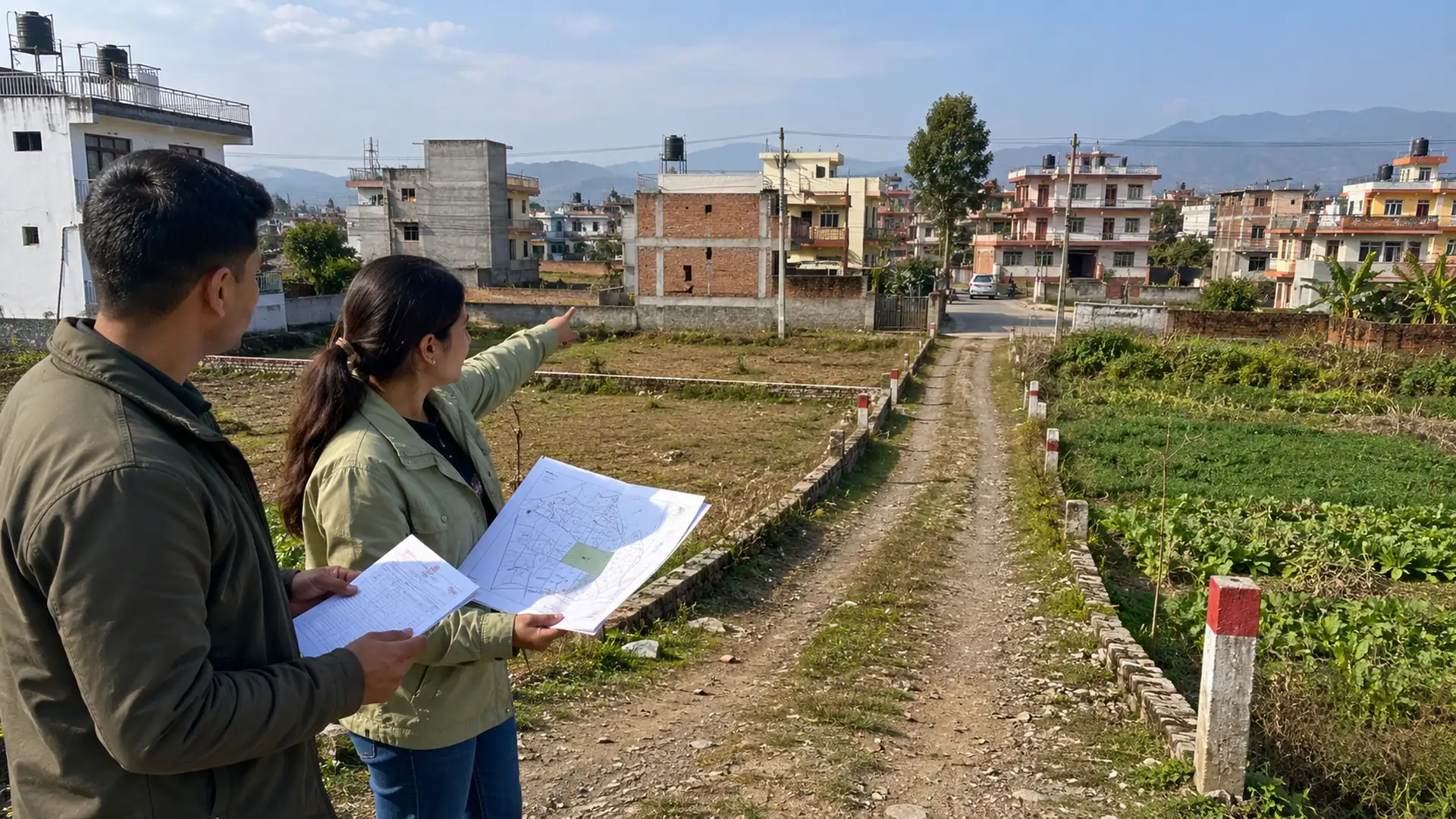
The most direct way to check right of way before buying land in Nepal is to confirm three things: that the land physically connects to a usable road, that this connection is recorded in official documents, and that your right to use it is legally enforceable and will survive a change of ownership — a visible road alone proves none of these on its own. At Punarvaasu Nepal, this is one of the core checks we walk buyers through before any advance changes hands. Here’s how to do it yourself, step by step.
Before we go further, a quick scope note: in this guide, “right of way” refers to a property owner’s legal ability to access land through an existing road, passage, or another parcel. It does not cover government road-widening corridors, highway right-of-way boundaries, building setbacks, or traffic right of way. Those are separate legal and planning matters. This guide is about one question only: can you legally and continuously reach the land you’re about to buy?
What Does Right of Way Mean When Buying Land in Nepal?
Right of way, in the property sense, is the legal ability to pass through one piece of land to reach another. For a buyer, it matters most when a plot doesn’t sit directly on a public road — interior plots, subdivided family land, and shared-access developments are the situations where access problems most often surface.
The confusion usually comes from treating “there’s a road” as a single fact, when it’s really three separate facts that can each be true or false independently:
- Physical access — a road or path physically exists and connects to the plot.
- Recorded access — that road appears in official maps or ownership documents.
- Legally enforceable access — the buyer will have a documented, transferable right to use it.
A plot can have any combination of these without having all three. Nepal’s Muluki Civil Code, 2074 addresses this directly — Part 4, Chapter 8 sets out the legal framework for servitude, including how a right of passage is established and protected. We’ll bring in the relevant sections as we go, at the point each one actually applies, rather than as a standalone legal summary.
Step 1 — Inspect Physical Access
Start at the property, not the documents — a document can describe access that doesn’t actually hold up on the ground.
Trace the entire route to a recognised public road. Don’t stop at the section directly in front of the plot — follow the full path back to a public road, and note whether it crosses any privately owned parcels along the way. A plot can have a perfectly usable frontage and still depend on a stretch further along that you have no secured right to cross.
Check for physical obstructions. Gates, walls, drains, narrowed sections, or encroachments can all interrupt a route that looks continuous on paper but isn’t continuous in practice. Compare what the seller describes against what you actually walk.
Confirm the access supports your intended use. A footpath is not the same as vehicle access. If you’re planning to build, ask whether construction materials can realistically reach the site. This is about practical usability, not municipal road-width rules — that’s a separate topic from what we’re covering here.
Step 2 — Check the Cadastral Map
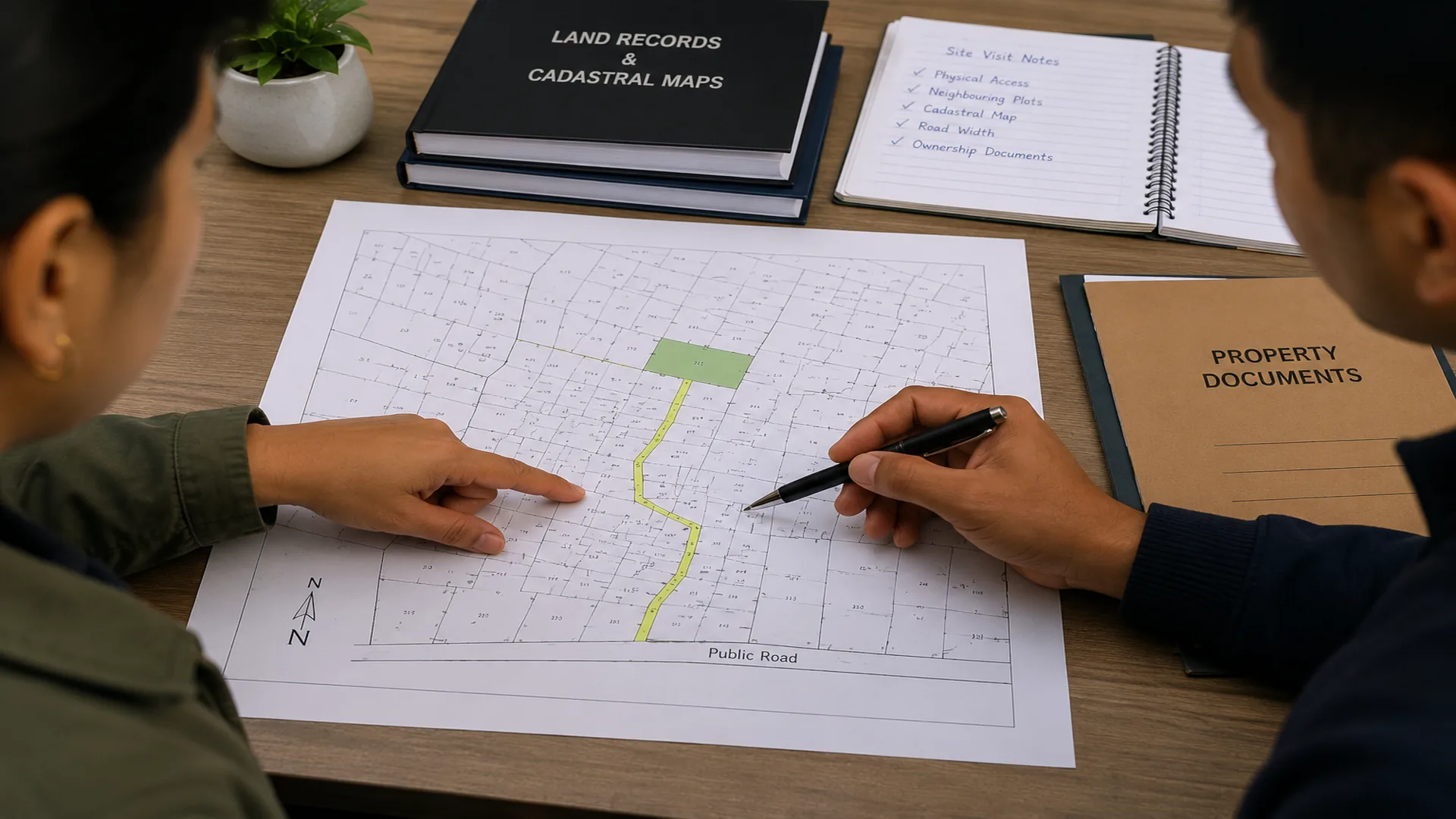
Once you have inspected the access in person, compare it with the official cadastral record — also called the naksa in Nepal’s land system.
- Locate the plot’s parcel number and check whether the access route is shown on the cadastral map.
- Confirm the mapped route connects continuously to a public road — not just up to a neighbouring parcel boundary.
- Note which parcels the route crosses, since each one may belong to a different owner.
- Don’t rely on a developer’s plotting or marketing layout as if it were an official record. A plotting or marketing layout is not, by itself, proof of legal access.
A cadastral map can suggest what type of access you’re dealing with, but it doesn’t confirm the legal right to use it — that comes next.
Identify the Type of Access
You can usually get a first read on which category applies from what you’ve already seen at the site and on the map — for example, another parcel’s boundary crossing your route suggests passage through another private parcel, while multiple names on the road parcel — the specific plot of land the road itself sits on and is registered under — suggests shared access. Different access types carry different risks and require different proof:
| Access type | What to verify |
| Public road | Official recognition and continuity of the route to the plot |
| Private road | Who owns the road parcel, and what right you’ll receive to use it |
| Shared or jointly owned road | Ownership shares, and how maintenance and obstruction are handled |
| Passage through another private parcel | Whether it’s backed by a registered servitude, deed, or partition arrangement |
| Informal access (neighbourly use, no documentation) | Whatever proof exists beyond the fact that people have used it |
Knowing which category you’re in tells you exactly what to ask for next.
Step 3 — Establish Whether the Access Is Legally Yours to Use
This is where you determine whether the access you’ve seen and mapped is actually yours to rely on.
Check the Lalpurja and transfer documents. Look for any mention of access, servitude, or route-related restrictions, and compare them against what the seller has told you. For a fuller rundown of what these documents should include, see our guide to documents needed to purchase or sell property in Nepal.
Review partition or subdivision documents, if relevant. If the plot was created by dividing family land, check how access was assigned at the time. Nepal’s Civil Code requires that a partition be carried out in a way that preserves a way or passage for each resulting share (Section 231) — so a subdivided plot with no clear route to a road requires closer review of the original partition and access arrangements.
Ask for the written basis of the access. This could be a registered deed, a partition deed, a separate servitude or access agreement, or an ownership share in the road parcel itself. A verbal understanding should not be assumed to create a documented or transferable right for the buyer.
Confirm the route and conditions of use. Which parcel does the passage cross? Where exactly does it run? Who is permitted to use it, and are there restrictions on vehicles or future widening? Nepal’s Civil Code addresses how a right of passage is acquired (Section 373) and protects the practical necessity of that access, including limits on selling or transferring a property in a way that cuts off its only route in or out (Section 374). Because of that, the access arrangement is something to sort out before the deal closes, not after. Section 377 speaks to the other side of this — once an exit road is in place, how it may actually be used.
Check whether the right continues after the sale. Where the servitude is legally attached to the property, a change of ownership does not necessarily extinguish the access right (Section 370). Disputes over servitude rights are also subject to a limitation period (Section 382), so this isn’t something to leave unresolved and revisit later.
Seek professional review when another private parcel is involved. If your access depends on crossing land you don’t own, this is worth a property lawyer’s or surveyor’s time before you commit. Section 381 may also be relevant where passage through another parcel involves compensation or raises questions about the burden placed on the neighbouring property.
By the end of this step, you should land on one of three outcomes: the evidence is sufficient, something is unresolved and needs more documents, or the situation needs a lawyer or surveyor before you go further.
Step 4 — Cross-Check With the Relevant Authorities
Documents establish a claim; the relevant office helps confirm it — though which office, and what it can actually confirm, depends on the question.
- Survey Office (Napi Office) — for cadastral mapping and boundary questions.
- Land Revenue Office (Malpot Office) — for ownership and registration records.
- Municipality or ward office — for local road status, municipal records, and any known local issues with the route, depending on which body maintains those records in your area. It’s also worth asking whether the office can issue a Ghar Bato Sifaris for the plot you’re considering — a certificate stating the width, type, and legal standing of the road linking that specific property to the public network.
None of these offices formally resolves an ownership or servitude dispute. If a genuine legal disagreement exists over who has the right to use the access, that’s a matter for professional legal advice or, if it comes to it, the courts — not something an office visit settles on its own.
Right-of-Way Red Flags Buyers Should Not Ignore
Some claims are common enough to expect, and each one deserves proof rather than trust:
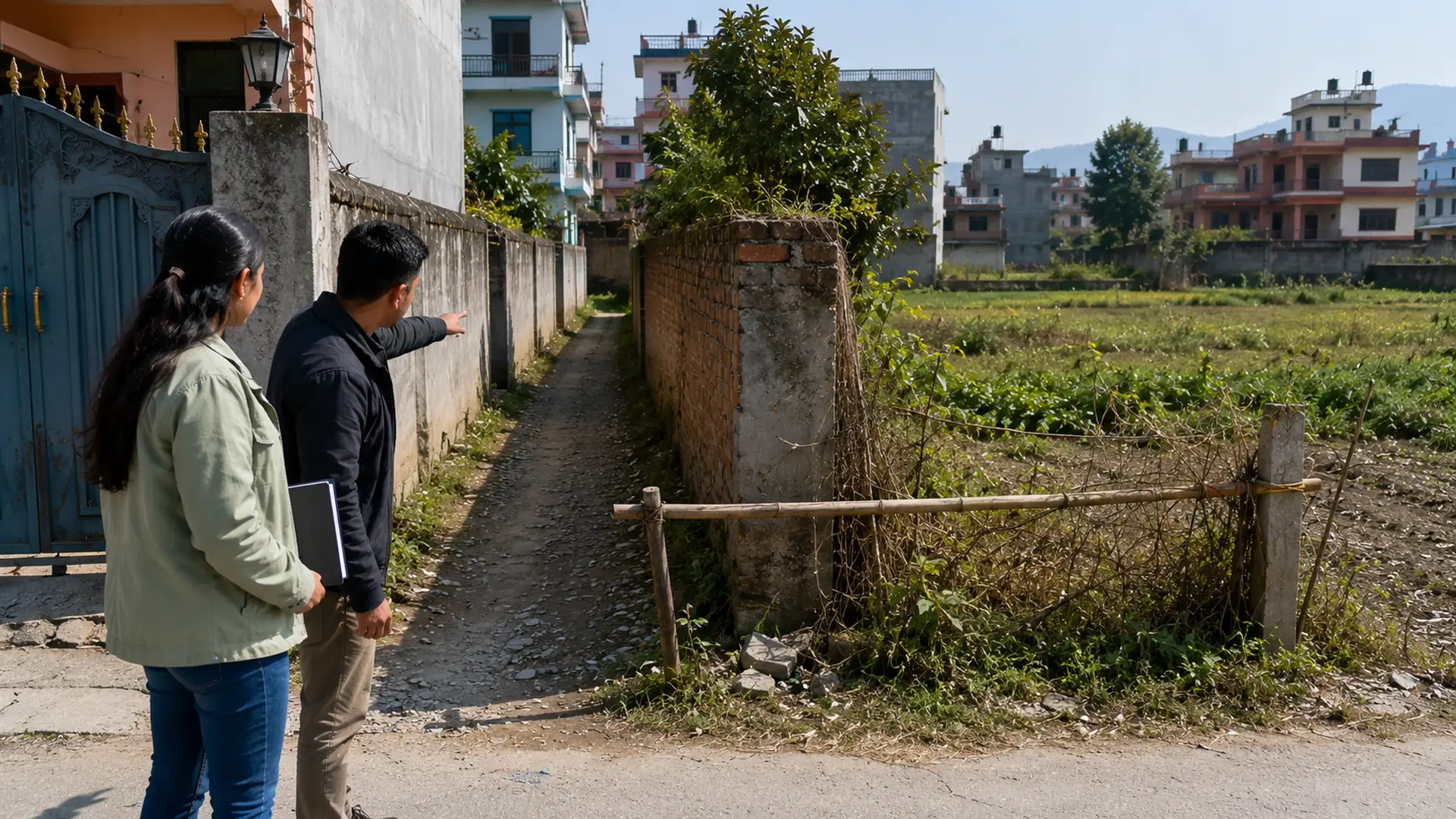
- “Everyone has used this road for years.” How long people have been using a route says nothing about whether that use was ever turned into an actual legal right — ask what documentation, if any, supports it.
- “The neighbour has verbally agreed to the access.” Ask for that agreement in writing before you rely on it.
- “It’s on the plotting plan, so nothing else is needed.” A marketing layout showing a road isn’t the same as that road existing on the cadastral map or being named in the ownership papers — ask to see both.
- “We can put the access agreement in writing after the property is registered under your name.” Push back on this — the moment registration is complete, you lose your leverage to insist on it.
- The seller can’t identify who owns the access road. This is worth pausing over on its own.
- The map, the site, and the deed show different routes. Ask which one is accurate, and get it confirmed at the relevant office.
None of these automatically mean walk away — they mean the claim must be supported by verifiable documents, official records, or professional confirmation.
Could Unclear Access Create Problems After Purchase?
These are not certainties, but they’re the four areas where an unresolved access issue tends to resurface later — usually at a worse time than now.
Financing and valuation. A lender reviewing the property may see unresolved access as a complication. Nepal Rastra Bank sets the overall lending framework banks operate under, but how much weight an access issue carries is left to each bank’s own case-by-case judgment — it’s a possible sticking point, not something that automatically sinks the loan.
Construction and development. Material delivery, utility connections, and vehicle access all depend on the same route you’re verifying now.
Disputes with neighbours or co-owners. A gate that gets locked, a passage that quietly narrows over the years, or a fight over who’s supposed to maintain the route — these tend to surface precisely where the access was never put in writing to begin with.
Resale. A future buyer will ask the same questions you’re asking now. Unresolved access can weaken your negotiating position when it’s your turn to sell.
Before You Pay an Advance

If any part of the access — physical, recorded, or legal — is still unclear, do not pay a non-refundable advance to hold the property. Pause the transaction, ask for the missing documents or verification, and proceed only once the access is properly supported. This is one of the few points in a land purchase where waiting costs far less than reversing a payment later.
Right of Way Verification Checklist
- Does the land physically connect to a usable, continuous road?
- Does the access appear on the cadastral map and match the site?
- What type of access is it — public, private, shared, or through another parcel?
- Is there a written, transferable right to use it?
- Will that right continue after the property changes hands?
- Has the relevant office confirmed the records?
- Could the access affect financing, construction, or resale?
- Has a lawyer or surveyor reviewed anything still unresolved?
Frequently Asked Questions
Is a visible road enough to prove the right of way in Nepal?
No. A visible road shows physical access, but not whether that access is recorded or legally enforceable — both need to be checked separately.
Can I buy land when the access road passes through another person’s property?
It’s possible, but only if that passage is backed by a registered servitude, deed, or similar enforceable arrangement — not a verbal understanding with the current owner.
Is verbal permission from a neighbour legally sufficient?
Verbal permission is not reliable evidence of a continuing and transferable right of access. Buyers should request written documentation and verify it against the relevant records.
What documents can help confirm the right of way?
The Lalpurja, transfer deed, partition documents (if applicable), and any separate access or servitude agreement. No single document should be treated as conclusive on its own.
What happens when land created through partition has no direct road access?
The plot doesn’t automatically gain legal access just because it needs it. Nepal’s law does provide a route to establish passage after the fact — generally involving compensation to the affected neighbouring landowner — but this isn’t automatic and usually requires proving the access is genuinely necessary. Start by reviewing the original partition documents to see whether access was meant to be provided and simply wasn’t; if it wasn’t addressed at all, this is a situation worth taking to a property lawyer before you proceed.
Can unclear right of way affect a bank loan or resale?
It can complicate both, though outcomes vary by lender and buyer. It’s a real risk worth resolving before purchase, not a certainty in every case.
Verify Access Before You Commit
A road being visible and a road being legally yours to use are two different things, and the gap between them is exactly what this checklist is built to close. Confirm the physical route, match it against the official records, and make sure the legal right to use it is documented and transferable — then, and only then, move forward with a payment you can’t take back.
If you’d like a second set of eyes on a specific plot’s access situation, Punarvaasu Nepal can help you review the available property information and coordinate the necessary checks before you commit.



Join The Discussion