
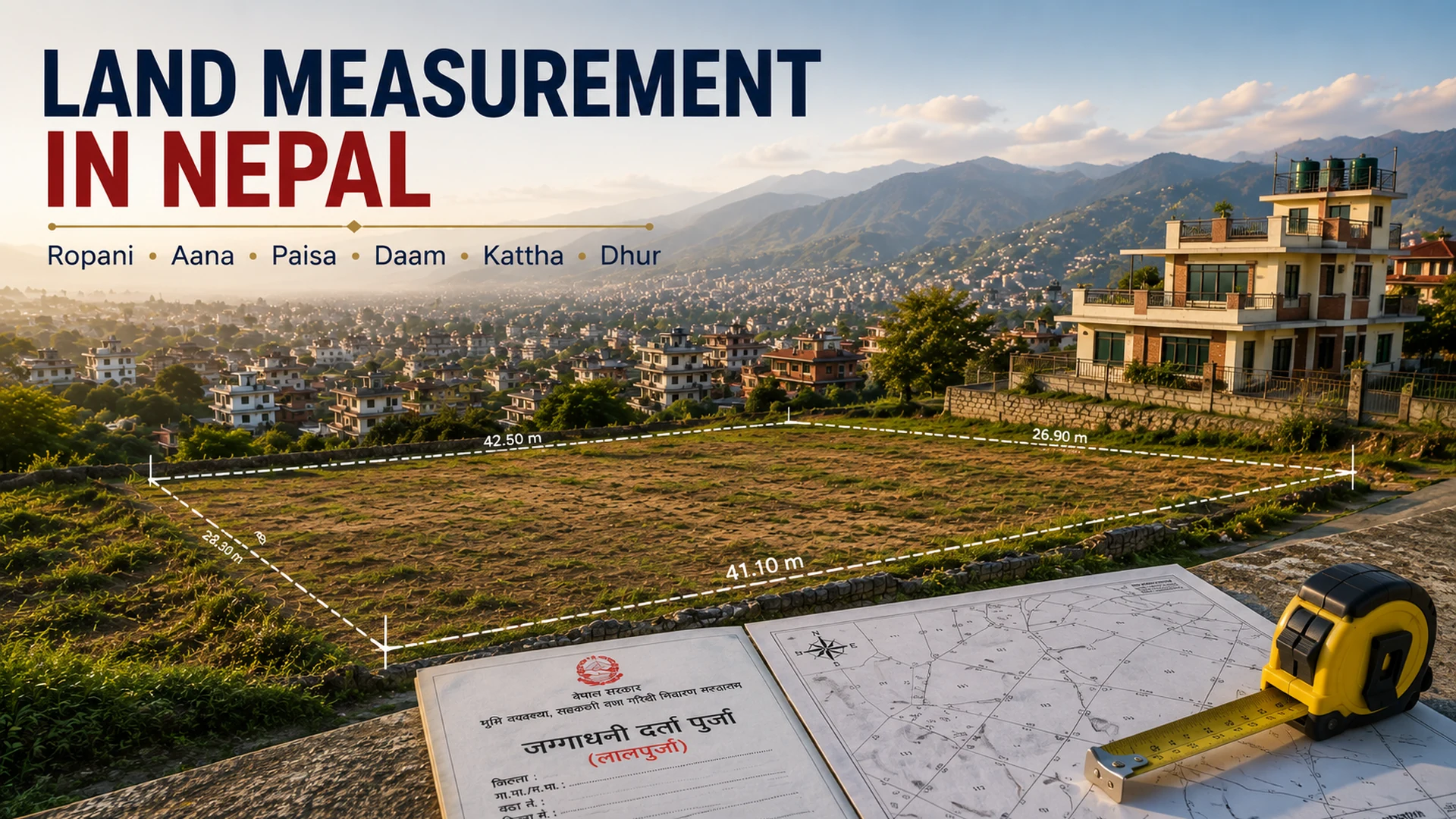
If you’ve ever looked at a property listing in Nepal and seen a plot described as “0-3-2-1” or “4 Aana 1 Paisa,” you’ve run into one of the more confusing parts of buying land here. Traditionally, Land Measurement in Nepal falls mainly into two systems, depending on where you are, the Ropani-Aana-Paisa-Daam system in the hills and Kathmandu Valley, and the Bigha-Kattha-Dhur system in the Terai. Each unit converts to square feet with a fixed, precise ratio, but that ratio is rarely explained in plain terms when you’re handed a listing or a deed.
Before you compare plots, calculate a fair price, or even understand what you’re being shown, it helps to know how these units actually work. At Punarvaasu Nepal, we work with these units daily across our Kathmandu, Lalitpur, and Bhaktapur listings, so here’s the breakdown buyers actually need.
Land Measurement Units in Nepal at a Glance
Here’s a single reference table covering both systems and their square-foot equivalents.
| Unit | Region | Equivalent | Square Feet |
|---|---|---|---|
| 1 Ropani | Hill/Kathmandu | 16 Aana | 5,476 sq. ft. |
| 1 Aana | Hill/Kathmandu | 4 Paisa | 342.25 sq. ft. |
| 1 Paisa | Hill/Kathmandu | 4 Daam | 85.56 sq. ft. |
| 1 Daam | Hill/Kathmandu | — | 21.39 sq. ft. |
| 1 Bigha | Terai | 20 Kattha | 72,900 sq. ft. |
| 1 Kattha | Terai | 20 Dhur | 3,645 sq. ft. |
| 1 Dhur | Terai | — | 182.25 sq. ft. |
The Ropani-Aana-Paisa-Daam system is used across the hill regions, including Kathmandu, Lalitpur, and Bhaktapur where most of Punarvaasu’s listings are based. The Bigha-Kattha-Dhur system belongs to the Terai, Nepal’s southern plains. The two use different units and belong to different regions, though both can be converted into square feet or square meters for direct comparison.
The split reflects Nepal’s geography more than any single national standard. The hill and valley system evolved around smaller, often irregularly shaped residential and terraced plots, which is why its units — Ropani down to Aana, Paisa, and Daam — scale in comparatively small steps. The Terai’s flatter, larger agricultural and residential parcels are measured in units that scale in much bigger jumps, from Dhur up through Kattha to Bigha.
For a buyer, what actually changes when moving between the two isn’t just the math it’s which unit a seller, a broker, or a government office in that area will default to using, and which unit you should convert to when comparing a hill-system listing against a Terai one. If you’re only ever looking at property within Kathmandu Valley, as most Punarvaasu buyers are, the Ropani-Aana-Paisa-Daam system is the one worth getting comfortable with; the Terai figures above are useful mainly for context or comparison.
Ropani, Aana, Paisa and Daam Explained
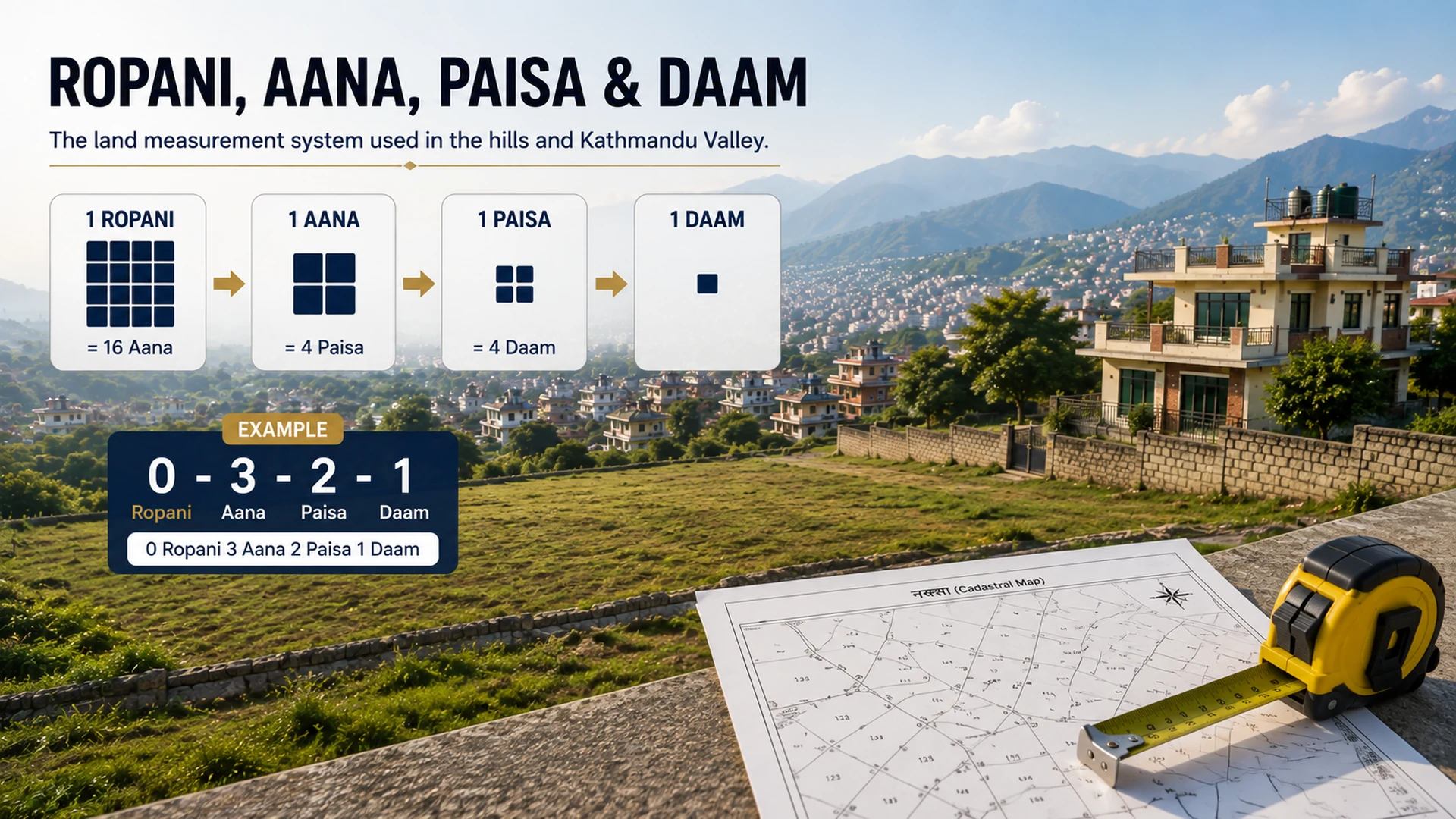
This is the system you’ll see on almost every Kathmandu Valley listing. A Ropani breaks down into 16 Aana, an Aana into 4 Paisa, and a Paisa into 4 Daam each step getting progressively smaller. In practical terms, 1 Aana works out to roughly 342 square feet, which is the unit you’ll most often see used to describe smaller residential plots. Paisa and Daam show up mostly in precise legal or cadastral descriptions rather than everyday listings.
Most residential listings are quoted primarily in Aana, sometimes with a Paisa or Daam remainder attached, which is why Aana tends to be the unit buyers get most comfortable working with day to day. A plot quoted purely in whole Ropani, with no Aana figure at all, is less common in denser residential parts of Kathmandu Valley — it usually signals a larger parcel. Refer back to the table above for exact conversions between any two units in this system.
Bigha, Kattha and Dhur Explained
The Terai system follows the same nested logic, just at a different scale. A Bigha contains 20 Kattha, and a Kattha contains 20 Dhur. In Terai property transactions, Kattha and Dhur are commonly used for smaller parcels, while Bigha — at roughly 72,900 square feet — is used for larger ones. Dhur, similarly, tends to appear only when a plot doesn’t divide evenly into whole Kattha, much like Paisa and Daam function within the hill system. Because a Bigha represents such a large area, most residential Terai listings are quoted in Kattha or Dhur rather than a fractional Bigha figure.
If you’re evaluating a Terai property, Kattha is usually the unit you’ll be comparing against square footage. The same table above covers all three conversions.
How to Read Land Measurement in Nepal
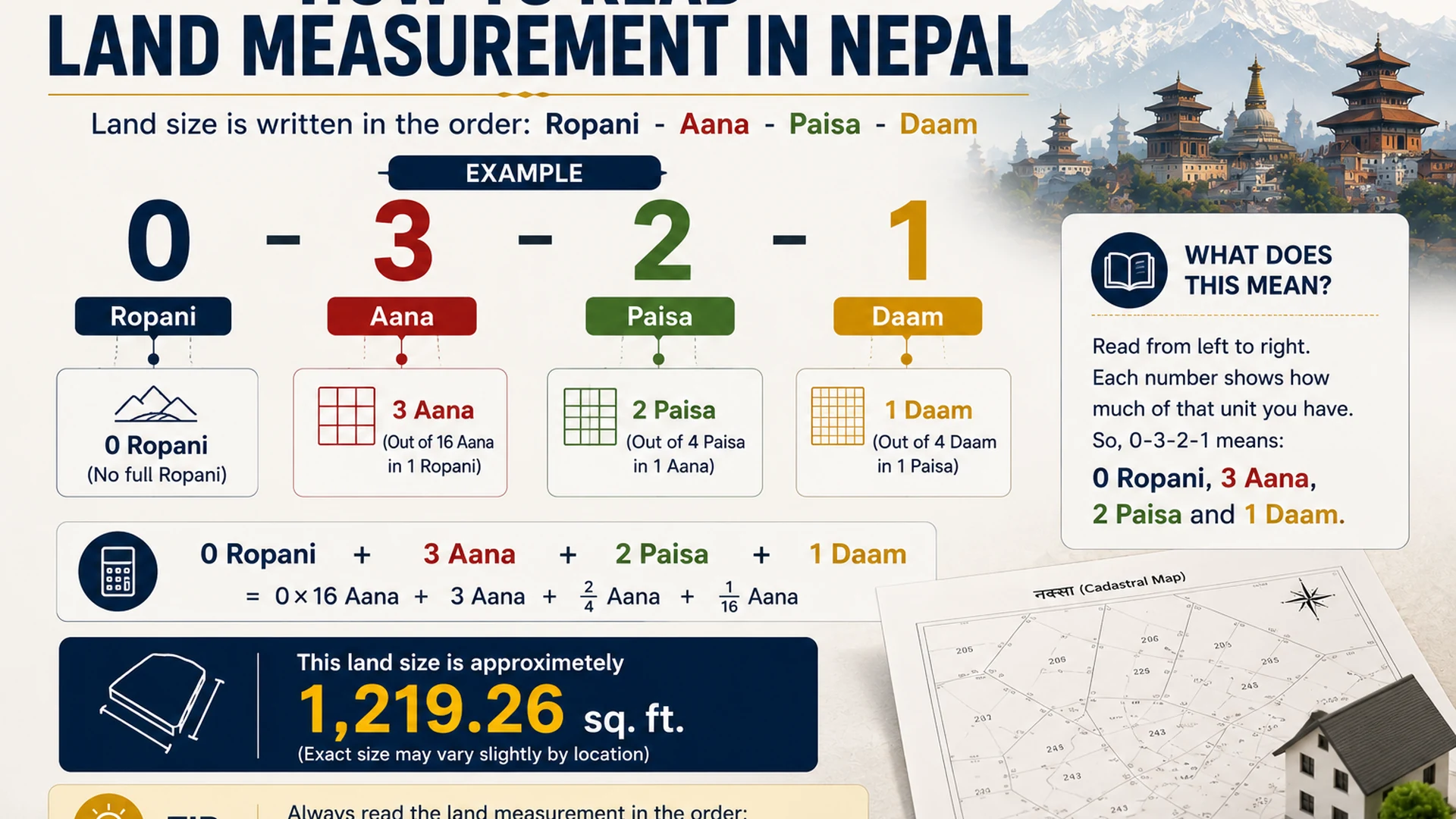
| Notation | Breakdown | Total Area |
| 0-3-2-1 | 3 Aana (1,026.75) + 2 Paisa (171.12) + 1 Daam (21.39) | ≈ 1,219.26 sq. ft. |
| 2-5-1-0 | 2 Ropani (10,952) + 5 Aana (1,711.25) + 1 Paisa (85.56) | ≈ 12,748.81 sq. ft. |
| 2 Kattha 10 Dhur | 2 Kattha (7,290) + 10 Dhur (1,822.5) | ≈ 9,112.5 sq. ft. |
Not every listing follows this exact four-number order, and older documents in particular can use different notation styles. If a size is written without labels or in an unfamiliar format, it’s worth confirming which units and order are being used before doing any calculation, a misread order can lead to a significantly wrong area estimate.
Terai listings follow the same logic with their own units. A plot listed as “2 Kattha 10 Dhur” means 2 full Kattha plus 10 Dhur beyond that — working out to (2 × 3,645) + (10 × 182.25), or approximately 9,112.5 square feet.
What Do Common Land Sizes Mean for Buyers?
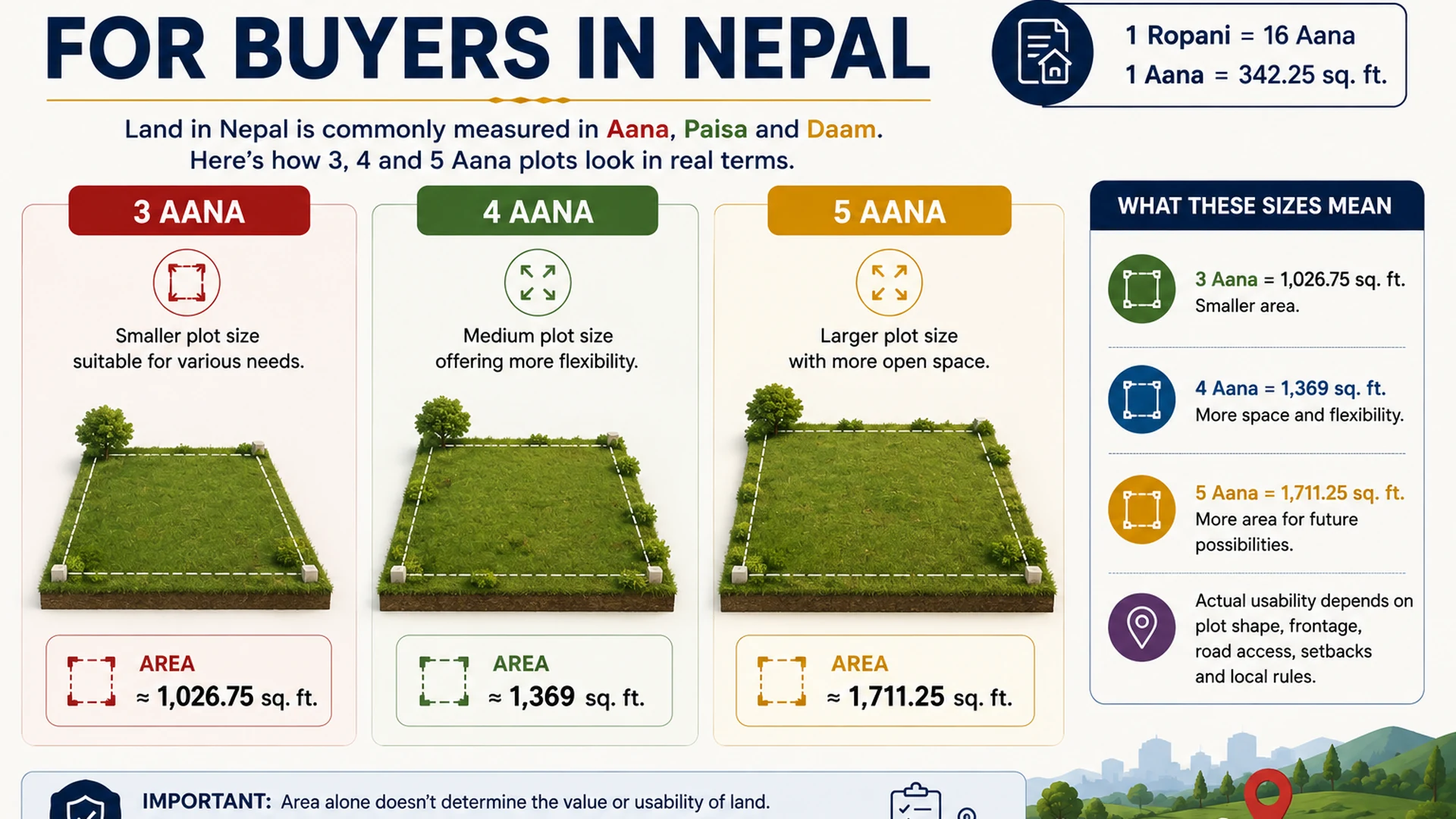
Numbers like “3 Aana” or “5 Aana” are easy to skim past without registering what they actually mean on the ground. Here’s what the common sizes work out to:
3 Aana: approximately 1,027 square feet 4 Aana: approximately 1,369 square feet 5 Aana: approximately 1,711 square feet
Property listings in Kathmandu Valley rarely land on a clean whole number, though. It’s just as common to see sizes like 3 Aana 3 Paisa, 4 Aana 1 Paisa, or 6 Aana figures that combine a base Aana count with a smaller Paisa or Daam remainder. Converting one of these is the same process covered earlier: work out each unit separately and add them together. A plot listed as 4 Aana 1 Paisa, for instance, comes to (4 × 342.25) + 85.56, or roughly 1,454.56 square feet noticeably more than a flat 4 Aana, which is easy to miss if you’re only skimming the headline number.
As land area increases, buyers have more total space to work with, but the usable or buildable portion cannot be determined from Aana alone. Plot shape, frontage, road width, required setbacks, and local municipal bylaws all affect how much of that area can actually be built on two plots of the same size can differ significantly once these factors are accounted for. Larger listings in the 8 to 14 Aana range, which also show up regularly around Kathmandu, Lalitpur, and Bhaktapur, follow the same principle: more square footage on paper doesn’t automatically translate to a proportionally larger buildable footprint.
Knowing what an Aana figure translates to in square feet still makes it much easier to shortlist listings worth a closer look, rather than relying on photos or the number alone. It also makes comparing two differently worded listings one quoted in a round Aana figure, another in Aana-Paisa-Daam — a matter of quick math instead of guesswork.
Why Land Measurement Matters When Buying Property
Once you can read and convert land units confidently, you can compare properties on equal footing rather than going by listing price alone. Two plots priced similarly can differ significantly in actual size, so calculating price per Aana (or per Kattha, for Terai land) gives you a much clearer sense of value than the total price tag does.
Here’s how that works in practice. Say two 4-Aana plots in a similar part of Kathmandu Valley are listed at NPR 1.2 crore and NPR 1.35 crore. On price alone, the first looks like the better deal. But if the cheaper plot is actually closer to 3.5 Aana once the documented area is confirmed, the per-Aana cost shifts considerably, and the comparison changes. Working out price per Aana on both properties’ total price divided by the confirmed Aana figure turns two listings that look hard to compare into numbers you can actually weigh against each other.
Price per Aana shouldn’t be treated as the only factor, though. Road width, frontage, plot shape, and how developed the surrounding area is can all justify a higher or lower rate for otherwise similar-sized land. It’s a comparison tool, not a final verdict on which plot is the better buy.
It’s also worth checking that the advertised area matches what’s documented. Occasionally, a listed size and the officially recorded size don’t quite align; a plot advertised as “4 Aana” isn’t automatically exactly 1,369 square feet once the Lalpurja is checked. Catching that early, before you’re deep into negotiations or have made an offer based on the wrong figure, saves considerable time, money, and trouble later.
Verify the Land Area Before You Buy
Before finalizing any purchase, the measurement shown in a listing should be checked against official documentation. The Lalpurja states the registered land area, and the Naksa (cadastral map) shows the plot’s boundaries and shape as recorded by the government. Comparing both against the physical plot — including boundary markers — helps confirm there’s no discrepancy between what’s on paper and what’s on the ground.
Discrepancies do happen, and not always through any fault of the seller. Older records may predate a boundary adjustment, a road-widening project, or a family land division that was never formally re-surveyed — a plot informally divided among siblings, for instance, might still carry a Lalpurja listing the original undivided area. None of this is necessarily a red flag on its own, but it’s exactly the kind of gap that only shows up once the documented figures are checked against the current physical plot, not from the listing description alone.
For larger purchases, or where boundaries aren’t clearly marked, it’s worth arranging a professional measurement rather than relying on the documents alone. A licensed surveyor can confirm the plot’s actual dimensions and flag any mismatch with official records before money changes hands, rather than after. We’ve covered this verification process in more detail in our guide on how to verify land in Nepal, which walks through what to check and why it matters before you pay an advance.
Getting Land Measurement Right Before You Buy
Nepal’s land measurement units aren’t complicated once you know the system behind them — Ropani, Aana, Paisa, and Daam in the hills and Kathmandu Valley; Bigha, Kattha, and Dhur in the Terai. Reading a plot’s size correctly, knowing what it actually means on the ground, and confirming it against official records are what separate a sound purchase from a costly surprise. Once you can convert the numbers and know roughly what you’re looking at, the next step is comparing that against real listings. Punarvaasu’s current property listings across Kathmandu, Lalitpur, and Bhaktapur are sized in these same terms — a good place to start once you know what the numbers actually mean.
FAQs
How many square feet are in 1 Aana?
1 Aana equals approximately 342.25 square feet — the unit you’ll see most often on smaller residential plots around Kathmandu Valley.
How many square feet are in 1 Ropani?
1 Ropani equals approximately 5,476 square feet — the base unit for the hill and Kathmandu Valley system, equivalent to 16 Aana.
How many Aana are in 1 Ropani?
1 Ropani equals 16 Aana, or roughly 5,476 square feet in total.
How many square feet are in 1 Kattha?
1 Kattha equals approximately 3,645 square feet, the unit most commonly used for Terai plots.
How many Kattha are in 1 Bigha?
1 Bigha equals 20 Kattha, working out to approximately 72,900 square feet — the largest standard unit in the Terai system.
Which land measurement system is used in Kathmandu?
Kathmandu Valley uses the Ropani-Aana-Paisa-Daam system for most traditional land measurements, common across Nepal’s hill regions.
How is land area written in Nepal?
Land area is commonly written as a four-number sequence — Ropani-Aana-Paisa-Daam — such as 0-3-2-1, representing 0 Ropani, 3 Aana, 2 Paisa, and 1 Daam. Terai listings follow the same idea using Bigha-Kattha-Dhur.



Join The Discussion