
You’ve inherited land from a parent or relative in Nepal — or perhaps it was gifted to you — and now the property sits there, still listed under someone else’s name in government records. Before you can sell it, develop it, or even use it as collateral for a loan, that has to change. The process is called Jagga Namsari — the legal procedure used to transfer inherited land into your name in Nepal’s government records. It’s the first requirement before you can sell, develop, or otherwise make use of the property, including putting it on the market if that’s the direction you eventually choose.
This guide walks through what Jagga Namsari actually means, when you need it, what documents to prepare, and what the process looks like from start to finish — so you can move from “I’ve inherited land, now what?” to having it properly, legally yours.
What Is Jagga Namsari?
Jagga Namsari is the official process of updating Nepal’s land ownership records — held at the Malpot (Land Revenue) Office — to reflect a change in who owns a piece of property. The term translates roughly to “name transfer,” and it’s what makes you the recognised legal owner in the eyes of the government, rather than just the person who happens to be using or holding the land.
Without completing Namsari, the land remains officially registered under the previous owner’s name — even if you’ve inherited it, received it as a gift, or have a family agreement that says it’s yours. That gap between legal ownership and actual possession is a common source of land disputes.
Common Situations Where Namsari Is Required
Namsari applies any time ownership of land changes hands. The most common triggers are:
- Inheritance — when a landowner passes away and the property transfers to their legal heirs
- Gift — when an owner formally transfers land to a family member or another party during their lifetime
- Succession or family settlement — when land is divided among multiple heirs or transferred as part of a family arrangement
Namsari is also a routine part of a property sale, since the buyer’s name has to replace the seller’s in the records. If you’re buying or selling property and want a full breakdown of that process, including registration fees and stamp duty, see our House Registration Cost in Nepal guide. This article focuses specifically on inheritance and gift-based transfers, where the process and the documents required look noticeably different.
Why Completing Jagga Namsari Matters
It’s tempting to leave inherited land as it is, especially if there’s no immediate plan to sell or develop it. But delaying Namsari creates real problems down the line:
- You can’t legally sell, mortgage, or develop the land until it’s in your name. Buyers, banks, and the municipality will all ask for proof of current ownership — and if selling is eventually the route you take, our guide to selling land in Nepal walks through what that process looks like once ownership is settled.
- Disputes become harder to resolve. If multiple heirs have a claim and none of them complete Namsari, disagreements over who owns what tend to surface later — often once the land has become more valuable.
- Government records and reality drift apart. Property tax, fees, and legal notices are sent based on whatever name is on file. If that’s a deceased relative, you may not even receive timely notice of obligations or disputes.
- Inheritance-related Namsari is generally expected to be filed within 35 days of the previous owner’s death, as provided under Section 297 of the National Civil Code. Missing this window doesn’t prevent the transfer — the Land Revenue Office must still process it — but a late fee applies. Acting within the deadline avoids that cost and the administrative back-and-forth that late applications sometimes involve.
This is a common pattern: a family inherits land jointly, no single heir takes responsibility for Namsari, and the property sits untouched for years. Then a buyer shows interest, or one heir wants to sell their share and another doesn’t — and the family discovers that nothing can move forward until the ownership question is formally settled, by which point tracking down every heir’s documentation and agreement takes far longer than it would have at the outset.
None of this needs to be alarming — it’s simply paperwork that, left undone, slowly becomes more complicated rather than less.
Documents Required for Jagga Namsari
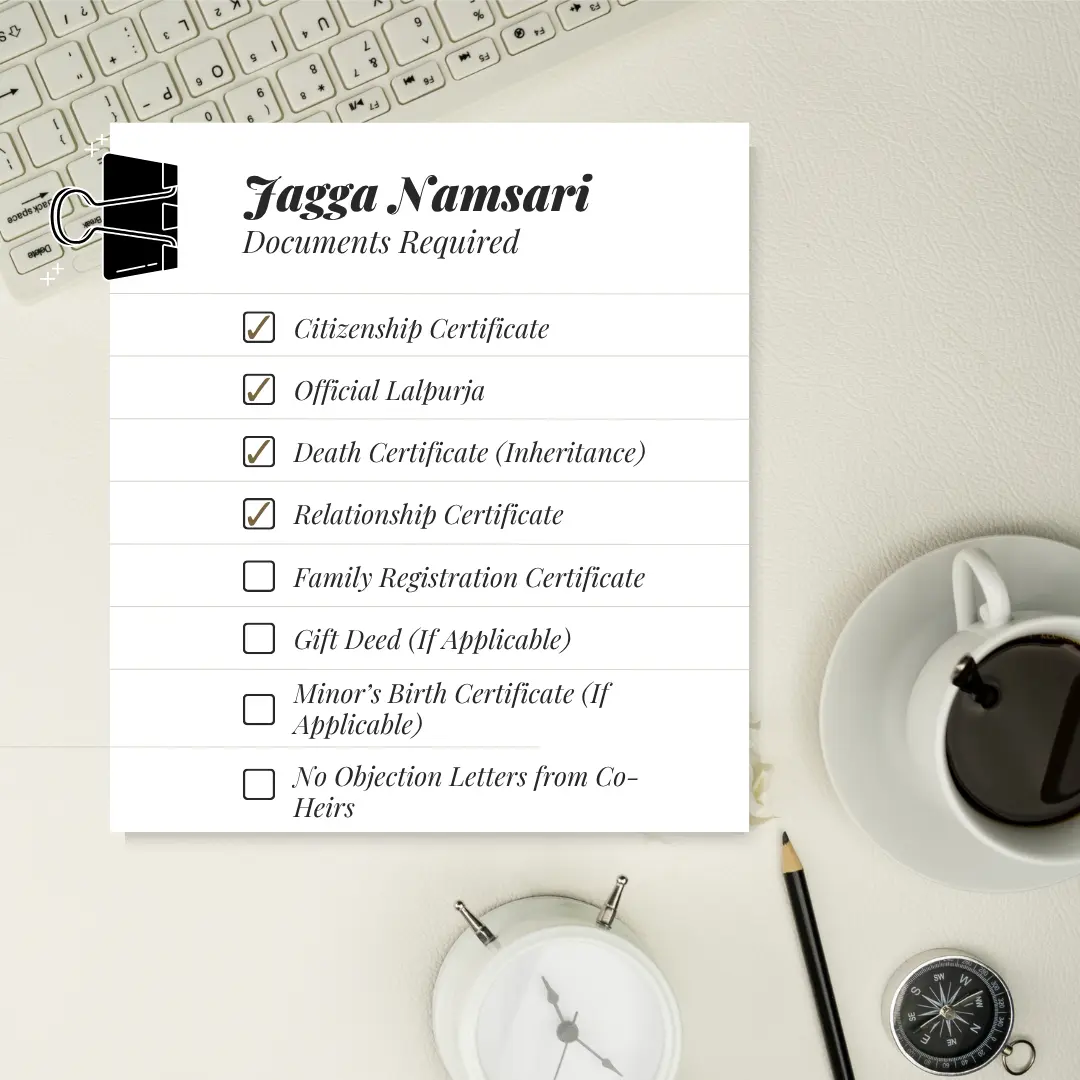
The exact documents depend on why the ownership is changing, but for inheritance and gift-based Namsari, you’ll generally need:
- Citizenship certificate of the new owner (and the previous owner’s, if available) — this confirms your legal identity against the name being entered into the land record.
- Original Lalpurja (land ownership certificate) of the property — the Malpot Office needs the existing record to update it; without the original, you may need to first apply for a duplicate before Namsari can proceed. If you’re unsure how to read or check the details on an existing Lalpurja, our guide to verifying land in Nepal covers what to look for.
- Death certificate, in the case of inheritance — this is what establishes that the previous owner is no longer able to hold the property, triggering the transfer.
- Relationship certificate from the local ward office, proving your relationship to the deceased — citizenship and a death certificate alone don’t prove you’re entitled to inherit; this document is what legally connects you to the previous owner as an heir.
- Relationship/inheritance proof documents, such as a family registration certificate, in cases involving multiple heirs — used to establish each heir’s individual share where the property is being divided.
- Gift deed, if the transfer is via gift rather than inheritance — a notarised document recording that the previous owner voluntarily transferred the property during their lifetime, distinct from an inheritance claim.
- Citizenship certificate and birth certificate of a minor, where a child is one of the heirs — since minors can’t hold legal documents independently, the Land Revenue Office needs proof of identity and a guardian on record.
- No-objection letters from co-heirs, where land is being transferred to one heir among several with mutual consent — without this, the Office has no way of knowing the other heirs agree to the arrangement, which can stall or block the application.
A missing document doesn’t usually end the process outright, but it does mean a second visit to the Malpot Office — and, in the case of a lost Lalpurja, a separate duplicate-certificate process before Namsari can even begin. Gathering everything in advance is the single biggest factor in how quickly the transfer goes through.
Step-by-Step Jagga Namsari Process
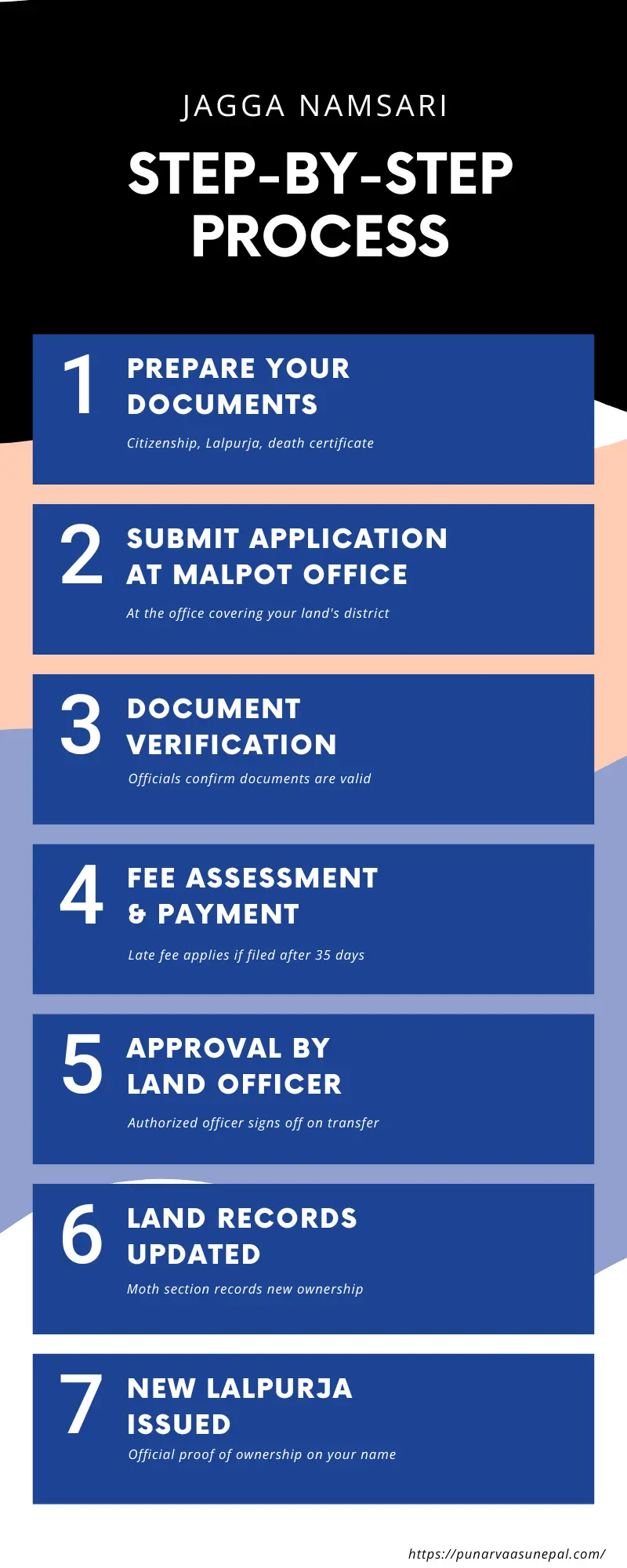
- Prepare your documents. Gather citizenship certificates, the existing Lalpurja, and the relevant proof of transfer (death certificate and relationship certificate for inheritance, or a gift deed for a gift transfer).
- Submit your application at the Malpot Office covering the area where the land is located, along with supporting documents.
- Document verification. Land Revenue Office officials review the application and confirm the documents are valid and complete.
- Fee assessment. Applicable charges are calculated. If the application is for inheritance and filed after the 35-day window, additional charges may apply depending on the office and circumstances.
- Approval by the land officer. Once verified, an authorised officer approves the Namsari.
- Records update. The Moth section updates the official ownership record to reflect the new owner.
- New Lalpurja issued. You receive an updated land ownership certificate in your name — the document that confirms you’re now the legal owner on record.
The process is administrative rather than legally complex, but it does involve multiple verification steps, which is why preparing complete documentation upfront makes a meaningful difference to how smoothly it goes.
Where the process gets more involved. A few situations commonly add extra steps to the timeline above:
- Lost or damaged Lalpurja. If the original certificate can’t be located, you’ll need to apply for a duplicate from the Land Revenue Office first, which involves its own verification process, before Namsari can be filed.
- Land that hasn’t been formally surveyed, or where boundary records are outdated. The Office may require an updated survey from the Department of Survey before approving the transfer, since Namsari relies on the land parcel being clearly and currently defined.
- Disagreement among co-heirs. If heirs can’t agree on how the land should be divided or who should hold it, the Land Revenue Office generally won’t proceed until the dispute is resolved — sometimes requiring mediation or a court decision before the application moves forward.
- Land under Rokka (hold). If the property has an existing hold placed on it — due to a loan, an unresolved dispute, or unpaid tax — that needs to be cleared before Namsari can be completed.
None of these are reasons to avoid starting the process; they’re simply worth knowing about upfront so they don’t catch you off guard partway through.
How Long Does Namsari Take?
Timelines vary by district and how complete your initial application is, but straightforward cases — single heir, full documentation, no disputes — are typically processed within a few weeks. Cases involving multiple heirs, missing documents, or unclear inheritance lines take longer, since the Land Revenue Office will require additional verification before approving the transfer. Filing as early as possible, with every document in order, is the most reliable way to keep the process short.
You’ve Completed Namsari — What Now?
Once the land is officially in your name, you’re free to decide what to do with it. Some heirs hold onto inherited land as a long-term asset. Others choose to develop it. And for many — particularly those living abroad or managing property they can’t actively use — selling becomes the practical option.
If selling is the direction you’re considering, having a clear, verified ownership record makes the process considerably smoother, since buyers and brokers will want to see exactly what you now have documented in Namsari. If and when you reach that point, Punarvaasu Nepal can help you list and sell inherited property across Kathmandu, Lalitpur, and Bhaktapur, with support navigating the documentation buyers typically ask for.
Procedures and requirements can vary depending on the district and individual circumstances. Before proceeding, it’s advisable to confirm current requirements with the relevant Malpot Office or a qualified legal professional.
Frequently Asked Questions
Is Namsari the same as land registration?
Not quite. Land registration is the broader process used when property is bought and sold — covering the sale deed, valuation, and stamp duty. Namsari is the specific step of updating the name on the official ownership record, which happens during a sale but is also required on its own for inheritance, gifts, and succession, without any sale being involved.
Can I sell land before completing Jagga Namsari?
No. The land must be registered in your name before you can legally sell it. Buyers and the Land Revenue Office will require proof of current ownership, which only exists once Jagga Namsari is complete.
Is there a deadline after inheritance?
Yes. Under Section 297 of the National Civil Code, an application for Namsari should be submitted within 35 days of the registered owner’s death. Missing this deadline does not invalidate the transfer — the Land Revenue Office must still complete it — but a prescribed late fee applies before the process can move forward.
Can multiple heirs apply together?
Yes. When land passes to more than one heir, all heirs are typically named in the application, or a no-objection letter is provided if the land is being transferred into one heir’s name with the others’ consent.
Can Jagga Namsari be completed online?
Some districts have begun digitising parts of the land record system, allowing certain steps — like checking application status or accessing existing records — to be done online. The core application, however, still typically needs to be filed in person at the relevant Malpot Office, along with original documents for verification. It’s worth checking with your local office directly, since the level of digitisation varies considerably between districts.
Is a lawyer required for Jagga Namsari?
Not strictly, for straightforward cases — a single heir, complete documentation, and no disagreement among family members. Where the situation is more complex — multiple heirs who need to formalise how the land is divided, a missing or disputed Lalpurja, a Rokka (hold) that needs to be cleared first, or any disagreement about entitlement — legal assistance is generally worth the cost, since it’s far cheaper to resolve those issues properly the first time than to revisit an incomplete or contested Jagga Namsari later.
Does Jagga Namsari cost money?
Yes, there are administrative fees, along with a late fee if filed after the inheritance deadline. For a full breakdown of registration and related costs in Nepal, see our House Registration Cost in Nepal guide.


Join The Discussion